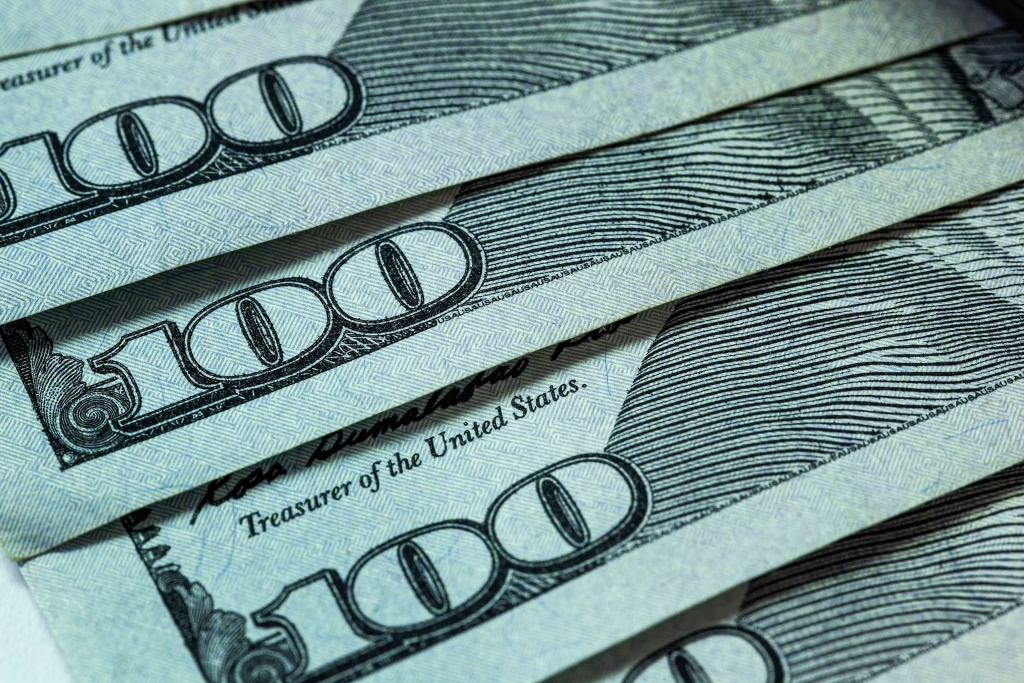
You may be wondering what these images are doing in a photography blog…
You see, there are objects you photograph because they are beautiful.
Others because they are strange.
And then there are those little pieces of greenish paper capable of turning seemingly normal people into sharks, saints into salesmen, friends into business partners, and entire societies into a gigantic shopping mall with the air-conditioning set too high.
Money.
Magnificent invention.
Terrible religion.
The first photograph feels almost cinematic: banknotes on a table, a cigar, a dagger beside them. All that is missing is someone saying “nothing personal” before making a business partner disappear into a trunk.
And yet it is perfect.
Because by accident it tells the story of much of our civilization.
Money.
Power.
Sometimes sex, for those who are not particularly skilled at relationships.
And something sharp in case anyone asks too many questions.
Welcome to the free market, children.
Bring your resume.
I have never believed that money itself was evil.
That conclusion would be too simple, and simple conclusions are most convenient when they do not explain a fucking thing.
Money is a tool.
A necessary one in a society of unevolved little creatures like us humans.
It lets you eat, travel, get medical care, build something, buy a camera, put gas in the car, pay someone for their work, and afford that extraordinary luxury called “not having to ask anyone’s permission.”
And that is exactly where it becomes interesting.
Because money does not only buy objects.
It buys time.
It buys possibilities.
It buys distance from problems.
It buys better lawyers.
Better homes.
Better schools.
Better care.
And once you have enough of it, it buys something even more important:
the ability to change the rules of the game while everyone else is still trying to figure out how the fucking pieces move.
At that point, we are no longer talking about a wallet.
We are talking about power.
The funny thing is, we managed to take a device invented to simplify exchange and turn it into the yardstick by which we measure practically everything.
How much do you make?
How much are you worth?
How much revenue do you generate?
What is the yield?
How much does it cost?
What is the return on investment?
Even a passion has to monetize.
A hobby has to become a side hustle.
A photograph has to sell.
A journey has to produce content.
A person with a following has to become a brand.
A relationship should preferably be functional.
Otherwise, what the fuck are we doing it for?
We have put a barcode on the soul itself.
And then we are surprised that we are depressed. No fucking wonder!
One day, someone decided a forest was no longer a forest.
It was a resource.
A river was no longer a river.
It was an economic opportunity.
A home was no longer the place where a family lived.
It was an asset.
A sick person was a customer.
And yes, this really is the deepest pit of oblivion.
A student was an investment.
A worker was a human resource.
Which is one of the most magnificently assholish expressions ever conceived by modern language.
Human resource.
Like coal.
Like oil.
Only with anxiety and mortgage payments.
And slowly we built a world where everything can be bought, sold, rented, privatized, listed, packaged, and resold to someone else at a twelve-percent margin.
Then perhaps we run a beautiful advertising campaign about sustainability.
So we are better people too.
But when you look closely at those banknotes, something curious happens.
The magic disappears.
You see the ink.
The lines.
The numbers.
The paper.
One hundred.
Another hundred.
And another.
Symbols to which we have collectively decided to grant enormous power.
And that is the fascinating point.
Money works because we believe in it.
This is not a technical critique of modern currency, nor do we need to imagine an underground room where twelve hooded men decide the price of Tuesday’s bread.
Reality is even more interesting.
We have built enormously complex economic, financial, and political systems that distribute possibility in radically unequal ways, then behave as if the result were a law of nature.
Like gravity.
Well, that is just how it works.
No, you fucking idiots. That is not how it works!
Gravity works that way.
We invented the economy.
And if we invented it, perhaps we can allow ourselves to ask whether some parts turned out like shit.
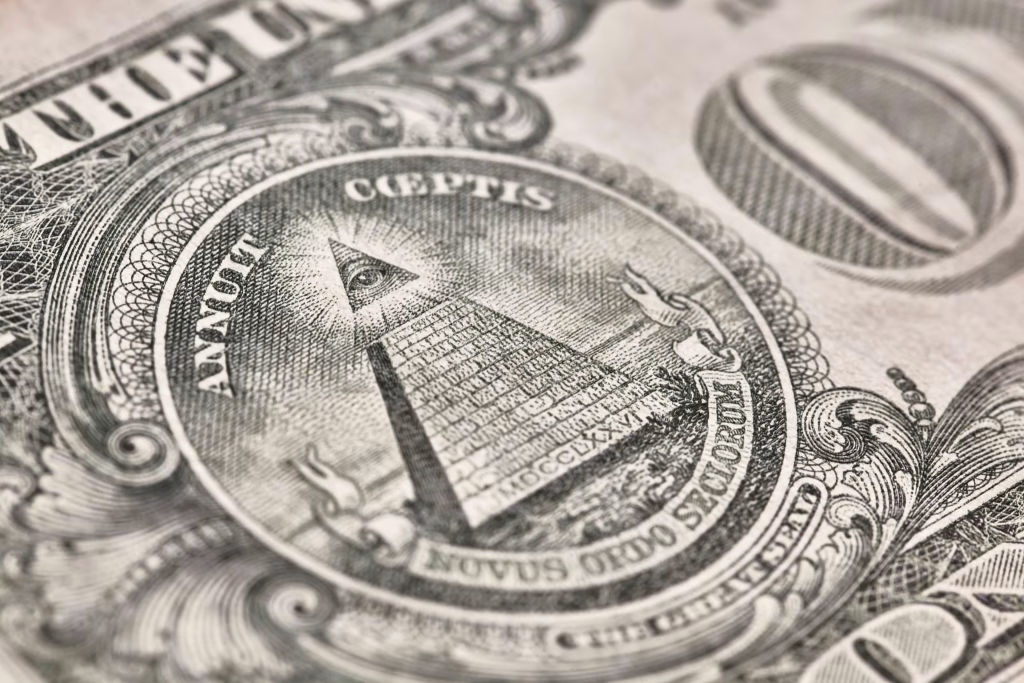
Then there is that symbol on the one-dollar bill.
The pyramid.
The eye.
One of the favorite images of anyone who has spent one night too many online after three whiskeys and a terrible romantic decision.
You can build any theory you want around it.
I am much more interested in what it represents visually.
A pyramid.
Very few at the top.
A great many at the bottom.
Now tell me that is not an effective enough metaphor for the world we live in.
You do not even need the conspiracy.
Just look at the distribution of power.
Some work their entire lives and still count every dollar at the end of the month.
Others own enough capital for the capital itself to produce more capital while they sleep.
One sets the alarm for six.
The other puts money in the right place.
Guess which one is described as “more productive.”
It is fucking economic poetry!
What truly irritates me is not that one person has more money than another.
Life has never been perfectly fair and probably never will be.
It is the worship.
That drives me out of my mind.
The idea that accumulation has become a moral virtue.
You have a hundred million?
You have to reach two hundred.
You have two hundred?
Five hundred.
Five billion?
Ten.
At a certain point, a person should be able to look in the mirror and say:
All right, I think I have enough to buy bread and ham until I die.
But no.
More.
Always more.
It is like playing Monopoly with people who have bought half the board, own the bank, and are meanwhile debating whether the others really need to keep Boardwalk.
And we call them visionaries.
There is something profoundly diseased about a system in which growth must never stop.
In medicine, any organism that grows without stopping generally has a less than reassuring name.
But when the economy does it, we put on a tie and raise a glass.
More production.
More consumption.
More revenue.
More debt.
More markets.
More customers.
More.
More.
More.
Like an addict swearing everything is under control while selling the television to buy the next dose.
And meanwhile the planet pays the bill.
People pay the bill.
Communities pay the bill.
But relax.
The quarter went well.
And perhaps this is the most absurd photograph sitting before us without ever being photographed.
Millions of human beings spending most of their days doing things they often dislike in exchange for numbers that will let them purchase a few hours of freedom over the weekend.
Then Sunday evening arrives.
And it begins again. Fuck, tomorrow is Monday already!
There is something magnificently perverse in the machinery.
We work to live.
Then end up living to work.
And in the end, someone even sells us a $799 online course explaining how to “take back our time.”
With three easy payments.
Naturally.
And yet money can do magnificent things.
It can fund research.
Art.
Travel.
Knowledge.
It can build hospitals.
Help someone.
Free a person from a terrible situation.
Give an artist time to create.
Allow someone to say no.
And perhaps that is its noblest use.
Not buying a Lamborghini.
Although, let’s be honest, a Lamborghini does not exactly suck.
But buying freedom.
The freedom to choose.
To stop.
To change direction.
To help someone without asking for anything in return.
The problem begins when the tool stops serving life and life begins serving the tool.
And I think somewhere along the way we completely fucked ourselves.
Because then comes the detail that ruins this entire marvelous orgy of accumulation.
We die.
I know.
Spoiler.
Terrible ending.
It does not matter how many zeros sit in the account.
At some point the heart stops beating, and the fortune immediately becomes the heirs’ problem.
You can own real estate, companies, stocks, land, yachts, funds, vaults, and perhaps even that ridiculous forty-thousand-dollar fountain pen you bought because a Bic apparently made you feel poor.
But when the time comes, there is no carry-on luggage for the afterlife.
You cannot show up before Saint Peter, karma, reincarnation, the cosmic void, or whatever waits on the other side and say:
Wait, I have an American Express Platinum card.
I am afraid they do not take cards.
And that is when the paper becomes nothing but paper again.
One hundred thousand dollars.
One million.
One billion.
Numbers.
While time remains the only true currency we cannot print, multiply, or buy back.
And paradoxically, it is the one we sell most cheaply.
For money.
For status.
Out of fear.
To prove something to people we may not even fucking like.
Excellent deal.
Perhaps the problem is not having money.
It is forgetting what money is supposed to buy.
A good life.
Experiences.
Time.
Freedom.
Dignity.
Possibility.
A little madness.
Something to leave others that is not merely a number in a will.
Because one day, all of this will end.
The bank will still open at eight thirty.
The stock market will open.
Companies will generate revenue.
Someone will buy.
Someone will sell.
Someone else will desperately try to become the richest person in the cemetery.
And the world will keep turning as though nothing happened.
I continue to think money is one of the most futile inventions humankind ever created.
And one of the worst deities it ever chose to worship.
Because money can buy almost everything.
The problem is that we began to believe almost everything was everything.
And that, dear readers, is probably the most expensive scam in history.