

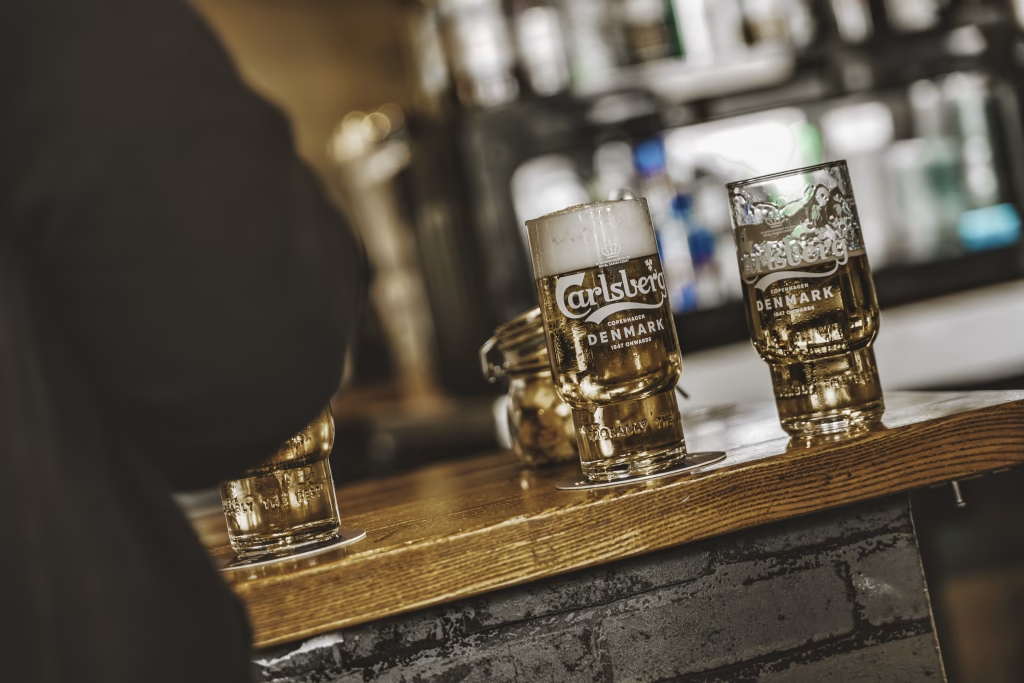
Two glasses on a bar.
Cold beer, foam, misted glass, and that golden light that, for some reason, can make even an ordinary afternoon feel poetic. No grand revelation, no miracle, no guru waiting to explain how to turn hops into a journey of personal growth.
Just something good to drink.
That should be enough.
And yet nothing is enough anymore.
Because we live in an age when even thirst needs a communication strategy.
Beer cannot simply be cold. It has to tell the story of a lifestyle. It has to promise friendship, freedom, seduction, success, adventure, and probably a better version of yourself, all inside a pint glass.
You are not buying a beverage.
You are buying a sunset with friends, a beach without screaming children, a group of remarkably attractive people laughing at a joke no one heard, and a life in which acid reflux and Monday mornings apparently do not exist.
Then you drink it.
And it is beer.
Maybe good beer.
Maybe even excellent beer.
But still beer.
Everything else was scenery.
And that is exactly the problem.
I do not hate the fact that someone communicates the existence of something. I do not mind knowing that a product exists, that it has certain qualities, and that I might like it. That is called providing information, and it is a perfectly civilized practice.
I hate the moment information is replaced by manipulation.
When they no longer show you what a thing is, but what they need you to believe it is.
When they speak not to your intelligence, but to your insecurities.
When the product no longer needs to be good because making it look desirable is enough.
That is when marketing walks onstage.
Well dressed, smiling, carrying a presentation full of corporate jargon and the moral conscience of a shark hired to sell life jackets.
Marketing does not sell objects.
It sells absence.
First it persuades you that a void exists inside you. Then, with admirable generosity, it offers the perfect product to fill it. Only until the next version comes out, of course, because a satisfied person makes a terrible customer.
You must always feel incomplete.
Not attractive enough.
Not young enough.
Not interesting enough.
Not accomplished enough.
Your car is old. Your phone is slow. Your home lacks style. Your clothes fail to express your personality properly, and even the water you drink could have a more coherent visual identity.
Fortunately, there is always something to buy.
An object.
A service.
A course.
A subscription.
A face cream priced like minor surgery.
Whether it works does not matter.
What matters is that you believe you need it.
Marketing has become the official religion of a world that no longer believes in anything except revenue.
Its priests do not speak of truth, but perception.
They do not ask whether something is good.
They ask how to position it.
They do not want to know whether a promise can be kept. They want to know whether it converts.
A lie that sells is called an effective campaign.
A truth that does not sell is filed under communication problem.
And so we began building everything backward.
First we decide how something should appear.
Then, perhaps, we try to produce it.
First comes the packaging.
Then the content.
First the story.
Then, at the bottom of the list and provided it does not cost too much, reality.
These photographs show beer.
The brand is incidental. It could have been another, because the words printed on the glass are not what interest me. I care about the color, the light, the foam clinging to the glass, the coolness suggested by the droplets, and the simple pleasure of something resting on a bar, waiting to be drunk.
And here an interesting contradiction arises.
Because by photographing it this way, I too am making it desirable.
I choose the angle.
I wait for the light.
I focus on the glass and let the rest of the room dissolve into a soft confusion of shapes. I turn an ordinary drink into a small cinematic scene.
Is that not marketing too?
Perhaps.
Or at least it could become marketing.
A photograph can tell the truth or package a lie. Sometimes it does both at once, because truth has never been a particularly orderly creature.
For me, the difference lies in the intention.
I do not want to persuade you that drinking that beer will make you more fascinating, freer, or surrounded by friends who look as though they walked out of a casting call.
I only want to show you a pleasure.
A cold glass.
A pause.
Something that, at the right moment, can simply be good.
Not everything has to change your life.
Some things can merely improve ten minutes of it.
And ten pleasant minutes in the middle of everything else are nothing to despise.
The problem begins when those ten minutes are turned into an existential promise. When someone takes a real sensation, hollows it out, packages it, and tries to sell it back to us as though they invented it.
Being together existed before advertising campaigns.
Taste existed before slogans.
Thirst existed long before some creative director decided to associate it with a group of smiling young people on a terrace overlooking Ibiza.
We already knew how to feel pleasure.
Then the experts arrived to explain which brand we were supposed to thank.
And it happened everywhere.
Travel became experiential tourism.
Food became content.
Love became couples’ personal branding.
Solidarity became corporate reputation.
Rebellion gets printed on T-shirts by multinational corporations that probably fire someone for arriving five minutes late.
Even authenticity is planned.
There are meetings in which perfectly serious people decide how to appear more spontaneous.
Someone opens a presentation and proposes a campaign that is more human, more real, more imperfect. Then they digitally correct every pore, select the highest-performing smile, and ask the public to believe in the naturalness of the result.
A marvelous simulation of life.
Everything looks real.
Provided nothing truly is.
And the worst part is that by now we are all forced to participate.
You can hate marketing all you like, but if you work, create, or try to live from what you know how to do, sooner or later you must kneel before its altar.
Being good is not enough.
You must know how to sell yourself.
Creating something valuable is not enough.
You must tell the story of your value, promote it, position it, sponsor it, and preferably post it when the algorithm is in a good mood.
You can be an extraordinary photographer, but unless you turn yourself into a small traveling press office, you will remain invisible behind someone who photographs worse and talks better than they photograph.
You can write an honest book, but first you need a community.
You can make music, paint, cook, or build marvelous objects, but someone will ask who your target audience is, how you plan to monetize, and what kind of engagement you generate.
The work is not enough.
You have to become the work’s salesperson.
And then the salesperson for yourself.
At that point, you no longer know where the thing you love ends and the character you created to make it marketable begins.
They have turned us all into products.
We describe ourselves with labels.
We optimize our bios.
We select the photographs.
We build coherent narratives, as though a real person could ever be coherent. We hide contradictions, bad days, fears, hesitations, and everything that fails to follow the editorial line of our existence.
Even people who proclaim they do not care about image spend a great deal of time building the image of someone who does not care about image.
Marketing always wins.
It has entered our way of thinking so deeply that now we even sell the refusal to sell.
And of course, all this is justified by profit.
The magic word.
Profit.
Revenue.
Growth.
Monetization.
Terms spoken with the solemn gravity once reserved for dignity, ethics, or at least the effort not to behave like absolute pieces of shit.
Profit should be a tool.
The healthy result of an activity that produces something useful, beautiful, or necessary.
Instead, it has become the goal.
It no longer matters what gets destroyed, exploited, poisoned, or emptied along the way. If the numbers rise, the presentation ends in applause and someone receives a bonus large enough to move far away from the consequences.
We make worse products because they have to cost less.
We make them last less time because we need to sell more of them.
We exploit people’s attention, fears, and vulnerabilities because they generate data.
Then we hire an agency to explain how deeply we care about the planet’s future.
A green leaf on the logo.
A moving sentence.
A few children running through a field.
And there you go: conscience scrubbed clean by the end of the quarter.
Marketing does not repair the damage.
It changes the font.
Perhaps that is why I like these images.
Because beneath all the superstructure, something elemental remains.
A glass.
A bar.
The light.
The gesture of lifting a drink and bringing it to your mouth.
You do not need a philosophy.
You do not need a brand identity.
You do not need to feel part of a tribe selected by an algorithm.
You are thirsty.
You drink.
You like it or you do not.
The body can still form an opinion without consulting a review.
It is a small form of freedom.
Of course, taste can be conditioned too. We learn to desire what we see constantly and regard as prestigious whatever we have been taught to value. No one is immune. Not even the person denouncing the system from a smartphone produced by that same system.
Myself included.
I am not outside this machine.
I live inside it.
I use it.
I feed it.
I photograph products, construct images, and try to make my work visible, because the romantic alternative to marketing is often failing to pay the bills.
That does not make me any less sickened by it.
It only makes me aware of the contradiction.
Perhaps we cannot completely stop selling ourselves.
But we can at least try not to lie too much.
We can show a thing for what it is.
Tell the story of its value without inventing a synthetic soul for it.
We can say a beer is cold, pleasant, and right for a particular moment without promising that it will cure loneliness or make memorable an evening spent with people who stare at their phones half the time.
We can learn again to distinguish desire from manipulation.
Storytelling from fraud.
Pleasure from promise.
It will not change the world.
The world enjoys being deceived too much, especially when the lie arrives in elegant packaging with free shipping.
But at least we might recover something.
Taste.
The real thing.
The ability to taste before deciding.
To look without someone suggesting what we ought to see.
To experience pleasure without immediately turning it into content, status, or a declaration of identity.
These photographs are not really about beer.
They are about everything that remains once we remove the brand, the slogan, the campaign, the target audience, and the latest smiling ambassador paid to tell us how sincerely they love a product they received free the week before.
A cold glass remains.
The light passing through it remains.
Someone who is thirsty remains.
And perhaps the simplest way to rebel against a world that wants to sell us even our emotions is to feel them again without first asking what they are worth.
Drink the beer.
Not the promise.
Taste the flavor.
Not the story someone built around it.
And remember that truly good things do not need to convince you they are good.
You only have to taste them.