

Some photographs are born to be seen.
They pass before our eyes, collect a few compliments, perhaps end up hanging on a wall or forgotten in a folder with the wrong name, alongside hundreds of other images we promise to revisit someday and naturally never will.
And then there are photographs born to be given to someone.
This was one of those.
It wasn’t merely a sunset. It wasn’t merely a sky colored the right way at the right moment, with the kind of light that almost looks like an error of nature. It was one of those rare occasions when the world, for a few minutes, seems to stop being the world and decides to give you something.
No traffic, no bills to pay, no people hurting one another while clumsily trying to love. Only the sky opening above your head, reminding you that despite all the shit we’ve managed to build down here, something still exists up there that needs no permission from us to be magnificent.
She had fallen in love with that photograph.
Not in the distracted way someone taps a heart beneath an image and moves on to the next. She had stayed inside it. She had gone back to look at it, talked about it more than once, as if she had recognized something of herself in those colors, something she could never quite explain.
She said she loved skies to death. That she wished she could climb inside them, fly through those colors, and disappear for a while.
Not because she didn’t love life, perhaps.
But because sometimes life is heavy.
Heavy when it piles onto your shoulders without asking permission. When the days become a line of problems to solve, responsibilities to bear, and thoughts that keep knocking even after you’ve turned out the light. Heavy when everyone seems to want something from you and you no longer know what’s left for yourself.
Sometimes you carry so many thoughts that the mere idea of escaping into an empty sky feels like a kind of freedom.
No luggage required.
No tickets.
No need to explain to anyone why you’re leaving.
You simply lift off the ground. Leave below you the noise, the questions, the people asking you to be stronger, simpler, happier, more like whatever would be convenient for them. You keep climbing until everything is small enough that it can no longer hurt you.
And perhaps that was exactly what she had seen in that photograph.
Not a sunset.
A way out.
A place to hide without apologizing. An impossible promise, certainly, but impossible promises are often the only ones still capable of holding us upright once the real ones have disappointed us enough.
I printed that photograph for her.
Because some images, once they become important, stop being mere files on a hard drive. They become something you can hold. Something that truly exists.
A file can be closed, moved, duplicated, accidentally deleted. A print takes up space. Collects dust. Stays there, reminding you it exists even when you pretend you’ve forgotten it.
You look at it and know why you made it.
You know who you chose it for.
You know what you hoped to say by handing it over, even though you probably would never have found the right words. Sometimes we give a gift precisely to avoid explaining everything. We let an image speak for us, hoping it will be braver, more beautiful, and less fucked up than we are.
She had entered my life the way certain people do: without knocking and without worrying much about what they might knock over on the way in.
We had met the way almost everyone meets now: through a screen, a few photographs, sentences thrown into the void, and that absurd modern conviction that you can understand a person by studying what they choose to show the rest of the world.
Then we met for real.
And it was different.
Conversation flowed without that awkward strain of two strangers desperately hunting for a subject rather than admit they have nothing to say to each other. There was curiosity. Attraction. That rare and dangerous feeling that something was happening before either of us had time to decide whether it was a good idea.
Naturally, it wasn’t.
The best things rarely are.
She had just come out of a relationship, or so it seemed. But some relationships don’t end when someone closes a door. They go on living in reflexes, fears, messages that arrive at the wrong hour, and that part of the body that keeps bracing for the worst even when no one is shouting yet.
She carried exhaustion, distrust, and more trouble than any sky, however magnificent, could truly contain.
And yet, when we were together, something seemed to grow lighter.
She said she felt reborn.
She said that with me she could forget the past.
Beautiful words.
Dangerous ones too.
Because being the place where someone forgets their pain can feel romantic until you understand that sooner or later, the pain comes back to claim them.
I tried to be more cautious.
Not because I felt less.
Perhaps precisely because I felt enough to be afraid.
When someone tells you that being with you is teaching them to live again, one part of you swells with pride like an idiot. The other wonders how long it will take before you become just one more thing they have to heal from.
So we moved forward.
One step, then another.
Moments when building something seemed possible, and others when reality returned to remind us that not everything born in intensity is meant to last. Sometimes intensity isn’t proof that a story will be great.
It’s only a sign of how much noise it will make when it breaks.
She kept talking about skies.
How much she loved them.
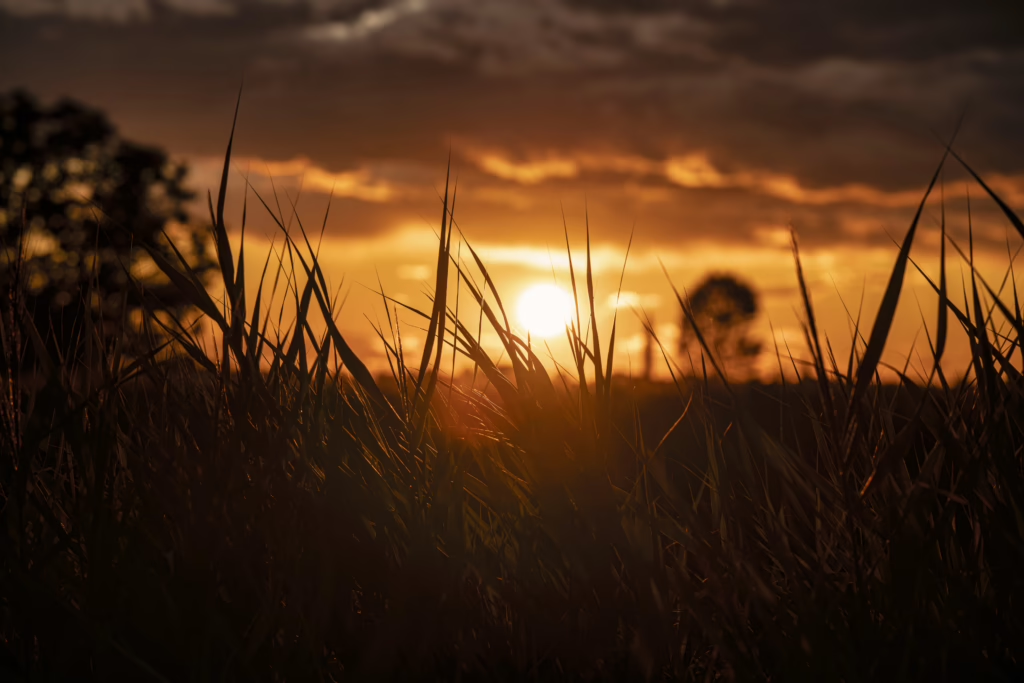
How badly she wanted to fly into them and away from everything pinning her to the ground.
I couldn’t take her up there.
I couldn’t free her from the past, fix her life, or turn myself into the reassuring hero who arrives at the right moment and puts everything back in place. Heroes work well in movies because the script cooperates. In real life they show up late, say the wrong thing, and often discover that nobody asked them to fucking save anyone.
All I could do was give her a sky.
Or at least try.
I had imagined the moment.
Her taking the photograph in her hands. Her eyes recognizing that sky at once. Perhaps a smile, perhaps that particular silence that comes when something strikes the right place and we don’t want to ruin it by speaking.
I imagined she would understand.
Not necessarily me.
The sky.
That, yes.
Except things change.
People change.
Roads head in different directions.
Sentences that seemed merely postponed become sentences that will never be spoken. Meetings still possible become missed chances. And the future, that great son of a bitch forever convinced it knows more than we do, takes what we had prepared and turns it into something else.
And that photograph stayed there.
Printed.
Ready to be handed to someone who never received it.
Perhaps the right moment no longer existed.
Or perhaps I hadn’t had the courage to create it while it still did. It’s hard to tell where fate ends and hesitation begins. We like to believe certain things never happened because they weren’t meant to. It’s more elegant than admitting we were afraid, arrived too late, or waited for a sign nobody had promised to send.
So the photograph stayed with me.
A kind of orphaned gift.
An object still holding its destination, though it never made the journey.
There is something strange about keeping something intended for somebody else. It’s almost like having an unsent letter, a sentence left unfinished, a final chapter nobody ever read.
The letter exists.
The words were written.
The feeling was real.
And yet, to the rest of the world, nothing happened.
Perhaps that’s the cruelest part of things never delivered: they continue to exist only for the person who prepared them. The other person doesn’t know what they lost. They cannot mourn it, remember it, or wonder where it went.
You carry both sides of the story.
The gesture and its absence.
The gift and the void left by its failure to arrive.
Sometimes I think I should have given it to her anyway.
Before the past came back and took her by the throat.
Her ex showed up out of control, ripped the phone from her hands, dragged her into one of those scenes that look exaggerated in movies and only uglier in real life. I was there with that printed photograph when he appeared from nowhere and suddenly insulted her, struck her, spat on her. He threatened to kill me while, on the other end, I heard enough to know something was going terribly wrong and too little to do anything that truly mattered.
She ended up in an ambulance, beaten badly enough to make any solemn sentence about justice sound ridiculous. He was still there without handcuffs, surrounded by impassive officers who did nothing to change the situation, while the usual Italian spectacle played out around them: everyone sees, someone comments, and the machinery of the State takes the stage with the punctuality of a drunken actor.
Perhaps there is a procedure for everything. A form, a report, a jurisdiction, and some office open only after tragedies have already made an appointment. But when a woman is assaulted, procedure looks terribly like an elegant word invented to explain why nobody managed to protect her in time—or worse, why nobody truly wanted to—as though her desire to sacrifice herself to that sky had become, in that moment, an absolute necessity.
Afterward came silence, fear, and the need to close doors that until the day before had seemed like the only passage worth crossing. And that photograph stayed with me, perfectly intact, while everything it had been printed for fell apart.
Without waiting for the perfect words, the perfect moment, or that mysterious alignment of the stars we invoke to excuse our inability to risk anything. I could simply have handed it to her and said, ‘This was for you.’
Five fucking words.
Sometimes life changes for much less.
But the past is full of men certain today of what they should have done yesterday. It’s our most useless talent. We all become brilliant once nothing can be fixed.
But perhaps some things never reach the person they were made for.
Perhaps some things remain with us because they are meant to remind us of a moment, a version of ourselves, an emotion that once seemed impossible to lose.
That photograph reminds me who I was when I printed it.
A man who still believed a sky could say what he couldn’t bring himself to speak. A man who had watched someone longing to fly away from her troubles and, unable to free her for real, had at least tried to give her a window.
It wasn’t much.
It was everything I had.
Perhaps art is also born from this helplessness: from being unable to save people, stop time, or repair what life has broken. So we photograph. We write. We print a sunset and hope it can do the work we were unable to do.
It can’t, naturally.
A photograph saves no one.
But it can remain.
And sometimes remaining is the only form of love still allowed to us.
That sky is still there today.
In the photograph.
In memory.
In that precise instant when two people looked at the same thing and, for a moment, saw something more.
She had seen somewhere to escape.
I, perhaps, had seen her trying to reach it.
And between those two things an image was born, meant to cross the distance between us but stranded halfway, as certain feelings do when they arrive too early, too late, or simply in the wrong life.
Meanwhile, the sunset ended years ago.
The light disappeared.
The clouds continued their journey without knowing they had been photographed, desired, and turned into a promise never kept.
But in the print they are still motionless.
Perfect.
Indifferent.
That’s what photographs do: they survive without the decency to age alongside us. They preserve a light that no longer exists while the people who saw it change, drift away, forget, or learn to live without what they once thought indispensable.
And perhaps that’s why I keep taking photographs.
Not to stop time.
Time will not be stopped. It only allows itself to be watched as it takes things from us, one after another, with the professional calm of someone who’s been doing the job forever.
We photograph to leave evidence.
Evidence that the sky existed.
That someone loved it.
That someone thought of giving it away.
That at least once, two people shared the same small idea of freedom, even if they failed to carry it with them afterward.
Evidence that, at least once, something beautiful happened.
And perhaps not everything undelivered is truly lost.
Perhaps some gifts change recipients.
That photograph was meant to remind her there was a sky into which she could imagine escaping.
It remained to remind me that, for a moment, I had wanted to offer it to her.
It isn’t the same thing.
It isn’t even enough.
But it is what remains.
A printed sky.
An unfinished story.
And all the distance in the world held between a photograph and the hands that never received it.