

I was thinking about something today:
The stupid thing about hearts drawn in the sand is that they come with an expiration date built in.
One wave.
A little wind.
Some distracted child.
A dog with no artistic sensitivity.
End of story.
And that is probably why, years ago, I decided to draw one specifically so I could photograph it.
For once, I had not found something in the world. I had put it there myself.
Usually, I prefer to wait for reality to perform its trick: someone laughing without knowing they are being watched, light falling in the right place, a street, an expression, a detail that lasts half a second and disappears. I arrive, raise the camera, and try to steal something before life changes its mind.
Not that time.
That time, I took the sand and drew a heart in it.
Yes, I know.
A heart in the sand.
The originality of a lovesick teenager on a school trip.
All that was missing were two initials, an arrow, and Bryan Adams playing in the background to complete the crime.
And yet that was exactly what I needed.
Because sometimes the most banal symbols continue to work simply because, beneath all the rhetoric we have piled on them, they still tell something true.
And love is probably the most exploited and, at the same time, most necessary thing we ever invented.
Assuming we invented it at all.
Maybe it was here first.
Before poetry.
Before marriage.
Before Tinder.
Before relationship coaches, podcasts about toxic partners, and people who put “emotionally available” in their bio, then disappear three days later because you wrote “good morning” with what they considered excessive enthusiasm.
Maybe love is much older than all of that.
Maybe it is the reason life keeps producing more life.
One cell seeking another cell. An animal protecting its young. Two human beings who, against all common sense and a fairly impressive history of failure, still decide to move closer.
The universe may have been born from love.
Or from a gigantic explosion.
Which, judging by my relationships, are probably the same thing.
The point is that we keep returning to it.
Always.
We can tell ourselves how independent, cynical, evolved, and self-sufficient we are. We can play the part of people who have figured everything out and expect nothing from anyone anymore.
Then a person arrives.
A look.
A voice.
A fucking coincidence.
And suddenly there we are again, with the brain of a primate on amphetamines and a heart that has unilaterally decided to tell every previous experience to go fuck itself.
Magnificent.
The human being.
A creature capable of building particle accelerators and still utterly incapable of handling a message marked read with no reply.
I have always had a curious relationship with love.
I do not believe I have ever known the kind of love found in a family saga, the kind that crosses decades, moves, bills, funerals, Sunday afternoons, wrinkles, broken washing machines, and the slow transformation of the other person into someone who knows every one of your worst habits and still decides not to suffocate you in your sleep.
Not that kind.
Not yet, at least.
I do not have that great story ending with “thirty years together.”
I have had something else.
A great deal else.
A fairly interesting collection of encounters, desires, bursts of enthusiasm, mistakes, nights, promises of varying credibility, departures, returns, closed doors, and the kind of conversation that begins with “we need to talk” and rarely ends with good news.
I have had passions.
Some magnificent.
Some decidedly less so.
And many times I have felt as though I were drowning in an ocean of insipid passions, which is nearly an artistic feat in itself: managing to drown in something with no flavor or, on the luckier occasions, only that faint salty aftertaste that at least reminds you that you are still alive.
But that does not mean I have not loved.
Quite the opposite.
Perhaps that is exactly where the paradox lies.
I have not had one love that lasted a lifetime.
But I have had many loves that, while they existed, were my entire life.
And that is an important distinction.
Because we have this strange need to measure authenticity through duration.
If it lasts thirty years, then it was real.
If it lasts six months, evidently it was bullshit.
I am not so sure.
Something can end and still have been genuine.
A song lasts four minutes, and no one accuses Beethoven of insufficient emotional commitment.
A sunset does not last long.
An orgasm, in the best-case scenario, even less.
And yet no one proposes abolishing them because they offer inadequate long-term guarantees.
Time certifies endurance.
Not necessarily truth.
I have met people to whom, at that precise moment in my life, I gave everything I had.
Presence.
Respect.
Desire.
Care.
The best part of me and, inevitably, a few pieces of the worst, because unfortunately love does not work like Airbnb: you cannot rent out only the freshly renovated rooms.
You arrive whole.
With the cracks.
The paranoia.
The wounds.
The past.
The absurd expectations.
The magnificent qualities you put in the window and the flaws you keep in storage, hoping the other person discovers them only when they are too involved to ask for a refund.
I have loved in the present.
That much is true.
Many times.
And perhaps that is why I cannot regard some stories as failures merely because they ended.
They ended.
That is not the same thing.
We have this fixation that everything ending must necessarily mean something went wrong.
A relationship ends: failed.
A friendship is lost: failed.
A project changes: failed.
By this logic, a life would be the ultimate failure, since statistically it ends in one hundred percent of cases.
Perhaps we should reconsider the metric.
Maybe certain people enter our lives not to remain forever, but to be there during exactly the stretch of road when we needed one another.
And then, enough.
Is it cruel?
Yes.
Is it romantic?
Depends how much you have had to drink.
Is it possible?
Absolutely.
The heart in the sand told that story too, though at the time I did not necessarily have the words for it.
I had drawn it.
It was there.
It existed.
It was real.
But it would disappear.
And the fact that it would disappear did not make the moment I traced it any less real.
If anything, perhaps it made it more important.
Because sand promises nothing.
It is not marble.
It is not concrete.
It is not a diamond ring with sixty-month financing.
It is temporary.
Fragile.
Vulnerable.
Exactly like us.
Someone might ask me:
— After all the stories that ended, do you still believe in love?
Yes.
— Are you serious?
Unfortunately.
— Haven’t you learned a fucking thing?
That is a possibility I consider daily.
But I still believe in it.
Not necessarily in the industrial version of love, the one packaged with mandatory anniversaries, coordinated photographs, and captions in which two people call each other “my rock” even though they may not have been able to stand one another since 2019.
I believe in the other thing.
In the moment when someone manages to become important.
In truly caring.
In looking at a person and sincerely wanting them to be well, even when their happiness offers you no direct advantage.
In wanting to share something.
A day.
A journey.
A bed.
A fear.
A sunset.
A portion of the future, however long it may be.
That stuff.
The part you cannot enter in a ledger.
Because in the end, we are surrounded by commercial transactions disguised as relationships.
I give you this.
You give me that.
I take one step.
Now it is your turn.
I texted you yesterday.
Today you have to text me.
Emotional bookkeeping.
And when we begin keeping the books, something is probably already dead.
The best love I know is not perfectly balanced every single day.
Sometimes you give more.
Sometimes you receive more.
Sometimes you are the strong one.
Sometimes you are the human disaster on the couch and the other person simply has to make sure you do not make any important decisions before tomorrow morning.
That is how it works.
And perhaps what I have always sought through all those stories that did not stay is precisely something like that.
Someone with whom I can stop being a tourist.
Because perhaps that is the problem with passion: it makes for magnificent journeys.
But sooner or later, somewhere inside you, the desire for a home is born.
Not necessarily a house with a white picket fence, two blond children, a Labrador, and Sundays at IKEA. God forbid.
A human home.
A person before whom you do not have to keep introducing yourself.
A space in which to be.
Stay.
Return.
That part of me exists.
Despite everything.
Despite the cynicism.
Despite having accumulated enough sentimental debris to open a small licensed landfill.
Part of me still wants something that lasts.
And perhaps fate has a particularly assholish sense of humor and keeps sending me magnificent stories with the staying power of a henna tattoo.
Or perhaps it is not fate.
Maybe it is us.
Maybe it is me.
Maybe life owes us no explanation, and the word “destined” is simply the elegant term we use when we are tired of analyzing our messes.
I do not know.
And this time, I do not even intend to pretend I do.
I know only that I have loved.
In my way.
At different times.
Different people.
With different intensities.
And every time, while I was inside it, I was not pretending.
That is enough for me.
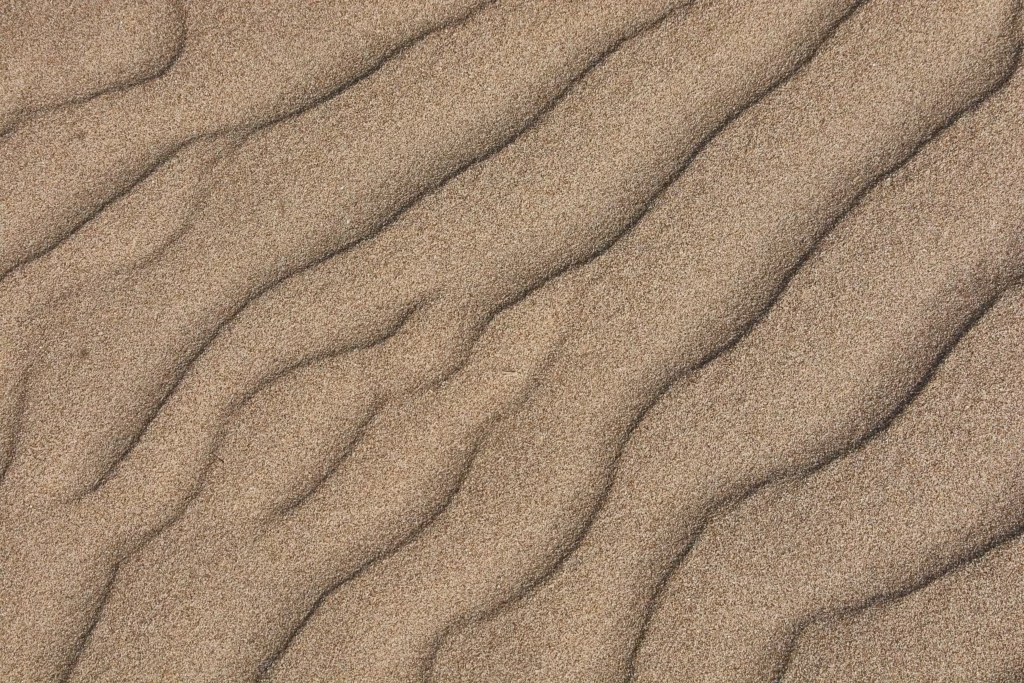
The second photograph does not even need the heart.
There is only sand.
Lines carved by the wind.
Curves that meet, separate, and return.
And perhaps it is even more interesting than the first.
Because it resembles real life far more closely.
No perfect symbol.
No recognizable shape.
Only trajectories.
The wind passes and draws.
Then passes again and erases.
And the sand does not protest.
It changes shape.
Maybe we should learn something from that too.
Do not stop loving merely because something might end.
Do not pretend that what ended did not matter.
Do not turn every goodbye into proof that we should have avoided meeting.
The waves will arrive anyway.
So will the wind.
People will change.
We will change.
Some will stay.
Some will not.
And some heart we drew with all possible care will be erased without even having the decency to wait until we are ready.
It sucks.
But that is the fine print beneath life’s contract.
Everything you love can be lost.
And that is precisely what makes love such a fucking courageous act.
Because you know it might end.
And you do it anyway.
You trace the heart.
You get sand on your fingers.
You fall in love.
You say things that may hurt one day.
You give someone the power to leave an emptiness inside you.
And you hope.
Which is probably the least rational and most human thing we know how to do.
Maybe one day I will have that great story, long enough to become boring in all the right places.
Maybe not.
Maybe I will keep meeting people destined to remain a chapter instead of becoming the whole book.
But I do not want to reach the end proud that I never got hurt.
That would be a miserable victory.
I would rather have a few scars.
A few memories.
A few names that return without permission now and then.
I would rather know I gave everything when I felt it was worth giving.
Sooner or later, the heart in the sand disappears.
Of course. It has already disappeared, swallowed by a wave or swept away by the wind.
But for one moment, it existed.
Someone drew it.
Someone believed in it enough to kneel down and trace that ridiculous shape with a finger.
And perhaps love, in the end, is not so different.
You cannot force it to stay.
You can only be honest while it is there.
Then the tide will come.
Or, once in a lifetime, perhaps it will not.