

Many women, no aftermath, and two old people on a bench who seemed to know the difficult part
Have you ever watched two old people sitting together and wondered how much life existed in the space between their bodies? How many arguments, how much joy, how many nights, and how many chances to leave had they crossed before arriving right there?
And you—how many people have you loved without being able to imagine them still beside you once your bodies had changed? How many times did you mistake the fire for love simply because it gave off enough light?
Perhaps the hardest part is not falling in love.
It is finding someone with whom to make it all the way to the bench…
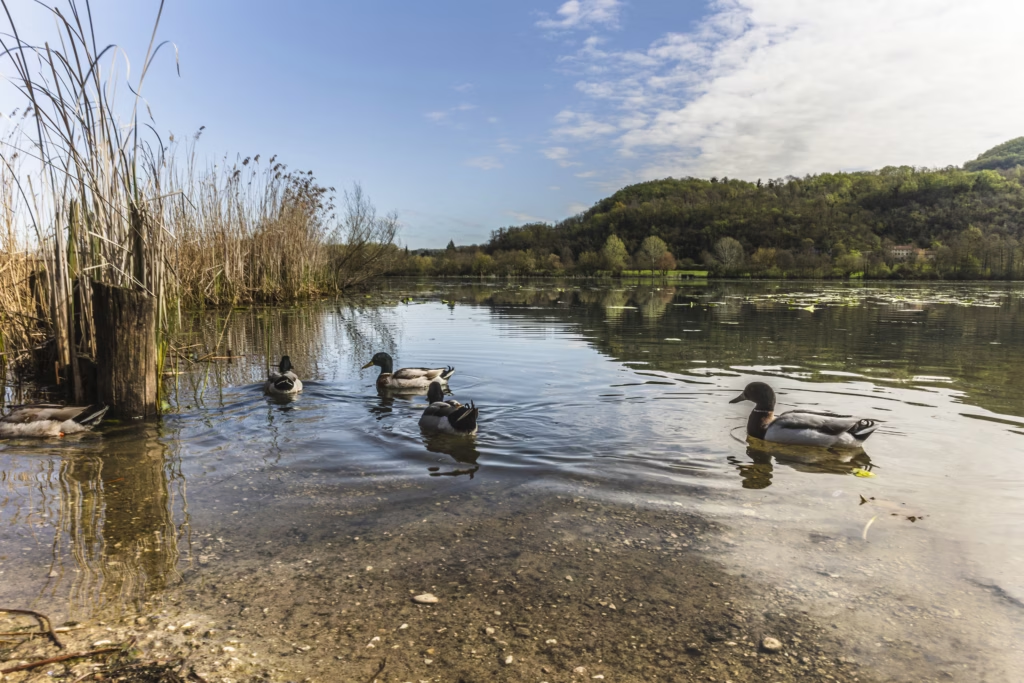
The lake looked fake.
Not fake in the offensive way of hotel pools, with mouthwash-colored water and a couple paid to smile inside the brochure.
Fake because it was too still.
The hills curved around the water.
The trees reflected on its surface with the precision nature employs when it wants to make us feel neglected by the design department.
The sky was clear.
The reeds barely moved.
A few ducks floated near the shore.
They did what ducks do.
They swam.
They ate.
They left rings on the water.
They did not volunteer to assist with my sentimental education.
It was healthy.
Faced with a lake, human beings immediately feel the need to assign it meaning.
Ducks do not.
Then I saw the bench.
Two old people were sitting there.
He wore a red jacket.
She wore a green sweater, her gray hair gathered behind her head.
They sat close together.
They were not embracing.
They were not holding hands.
They were performing none of those gestures we use to show other people that a relationship is proceeding according to the terms of its contract.
They were looking at the lake.
That was all.
And yet I stopped.
They were a couple.
At least, that was what I saw.
I did not need to ask how many years they had been together, inspect their documents, or summon any children as witnesses.
Certain kinds of closeness possess a grammar.
The distance between those two bodies did not seem empty.
It seemed inhabited.
They were not pressed together.
They were not apart.
They occupied the space with the calm of people who no longer need to keep checking whether the other is still there.
Perhaps they had spent forty years together.
Perhaps fifty.
They had argued.
Certainly.
No one spends half a century beside another human being without wanting, at least once or twice, to push them down a flight of stairs and declare it a tragic consequence of osteoporosis.
They must have said terrible things to each other.
And beautiful ones.
Probably some of the worst and the best in the same conversation, because love has an extraordinary ability to turn an ordinary question like “did you buy bread?” into a summary trial of the relationship’s entire worth.
Perhaps they had survived betrayals.
Or perhaps they had remained faithful.
Not only with their bodies.
Also in that more difficult way: never ceasing to consider the other person’s life important while your own keeps demanding room.
Perhaps they had raised children.
Lost people.
Buried parents.
Moved houses.
Paid debts.
Survived illness.
Spent wonderful Sundays together and others so boring they made death look like a recreational activity.
Perhaps there had been months when they barely touched.
Days when they failed to understand each other.
Silences used as weapons.
Doors slammed too hard.
Nights when one hand searched for the other beneath the covers, unsure whether it was asking for sex, forgiveness, or merely confirmation that the body beside it was still breathing.
And yet they had made it this far.
Not perfect.
Not intact.
Together.
Their bodies had grown old.
Their skin had surrendered to gravity.
Their hair had lost its color.
Their joints probably had more grievances than a French labor union.
The marketplace of desire would have swiped them away with one finger.
Too old.
Too ordinary.
No abs.
No pose.
No promise of acrobatic sex on sheets nobody would have to wash the next morning.
And yet they were beautiful.
Not beautiful despite time.
Beautiful because time had passed and they were still inside the same frame.
Their bodies no longer promised a future.
They contained one.
Every altered curve, every slower movement, every white hair might have been the trace of something they had survived.
A young body seduces through what might happen.
An old one tells everything that happened and failed to carry it away.
I was not moved because they were old.
I was moved by the possibility that they had grown old together.
That he had known her face before the wrinkles.
That she had seen his hair before it decided to abandon the project.
That they had desired each other when their bodies still possessed the arrogance to believe themselves eternal, and had remained when those same bodies began requiring patience, medicine, and more time to rise from a bench.
Perhaps they still fucked.
I hoped so.
Not out of morbid curiosity.
Or at least, not only that.
Old age does not sterilize desire.
It merely removes it from advertising.
Perhaps they still reached for each other at night, with less haste, a few more aches, and the comforting knowledge that neither possessed the energy required to impress the other with an especially athletic performance.
Or perhaps sex had changed its shape.
A caress.
A back brushed in passing.
The way he arranged a blanket across her legs.
The way she reminded him to take his medicine while pretending to be annoyed, because after so many years tenderness can become so intimate that it needs to disguise itself as a reprimand.
I watched them.
And I felt envy.
Not for old age.
I have not yet reached the point of longing for joint pain and weekly pill organizers.
I envied what I imagined had come before.
All the time required to reach that bench.
The days.
The nights.
The reconciliations.
The times one of them could have left and, for some reason, chose to stay.
I had known many women.
Quite a few.
Enough to call it experience, provided no one confused experience with competence.
A long list of relationships does not prove you know how to love.
It only proves you have sat through a lot of interviews.
Some women had left me.
Some had slowly disappeared.
First they withdrew their trust.
Then desire.
Then words.
Finally, the body.
Others had walked out slamming the door, metaphorically or with an acoustic precision that left little room for interpretation.
Some were unstable.
Others emotionally unavailable.
Some possessed both qualities, a particularly efficient combination if the goal was to turn a three-month relationship into a Balkan war with better sex.
Some wanted to be saved.
Some wanted to be left alone.
Some wanted both and changed their minds with the punctuality of a weather system.
But I had not only been the one left holding a drink while a woman carried away the last suitcase.
I had left many of them myself.
Some because I did not love them enough.
Others because I desired them, but not enough to imagine my life still there once the initial excitement had stopped taking care of the decor.
Some were wonderful women who arrived at the wrong time.
Some were the right moment inside the wrong story.
Some offered me precisely what I claimed to want, and I, with the emotional elegance of a man trying to put out a fire by pissing into the wind, found a reason to leave.
Sometimes I had been honest.
I had looked at the relationship, looked at her, looked at myself, and understood that continuing would only postpone the pain while increasing the interest.
Other times I had been a coward.
I left before I had to reveal myself completely.
Before novelty became intimacy.
Before a woman could learn the difference between the interesting character and the man who, after the show ends, remains alone in the kitchen wondering why the fuck he can never be satisfied.
I had hurt people.
Not always intentionally.
A distinction very useful to the guilty and almost irrelevant to the one bleeding.
I had promised things I believed when I said them and could no longer uphold a few months later.
I had confused intensity with duration.
Chemistry with destiny.
Freedom with the right to leave no permanent witnesses in my life.
Some women had been an escape.
Others a refuge.
Some both.
And I had been, depending on the period, the castaway, the storm, or that asshole who personally punches a hole in the boat and then looks at the sky wondering why God keeps sending him all that water.
It would have been convenient to say I had simply met the wrong women.
It was partly true.
I had developed a remarkable talent for recognizing emotionally unreachable people and calling it attraction.
An unavailable woman offers a great advantage to a man who is afraid of staying:
she allows him to long for a home while knowing the door will never open.
You can suffer.
Chase.
Write.
Idealize.
You can turn distance into a romantic tragedy elegant enough to avoid the less fascinating question:
if someone truly let me in, would I know how to stop looking for another door?
But not all of them were unreachable.
Some were there.
I was the one who could not, would not, or did not know how to stay.
Sentimental bookkeeping had no column for the innocent.
I had been abandoned.
I had caused abandonment.
My heart had been broken.
I had broken other women’s hearts.
Sometimes I had done both within the same relationship, because love is one of the few accidents in which you can be the victim, the one responsible, and the idiot who keeps driving without insurance all at once.
And yet, through all those women, I had continued looking for something.
I did not always admit it.
It was easier to tell myself I wanted freedom.
Experiences.
Bodies.
Stories.
No ties.
A life vast enough that I would never need permission to leave.
All true.
But incomplete.
Because beneath that hunger for novelty was another hunger.
Quieter.
More embarrassing.
The desire to find a woman with whom I would not have to choose between love and the rest of my life.
Someone who did not turn closeness into a prison.
Who did not ask me to stop being curious, traveling, taking photographs, writing, or chasing all those useless things without which I would no longer recognize myself.
But not someone I kept forever far enough away that I could run without leaving too much in the closet, either.
I wanted a woman capable of walking beside me.
Not behind.
Not ahead.
Beside me.
One with whom the world did not become smaller.
It became shared.
Perhaps that was what I saw on the bench.
Two people facing the same landscape.
They were not watching each other because they no longer needed to spend every minute studying one another.
They looked in the same direction.
They were still two individuals.
Two bodies.
Two stories.
But something existed between them that time had not completely torn apart.
Perhaps lasting love is not about merging.
It is about remaining close enough to keep seeing the same horizon without preventing each other from possessing your own eyes.
Passion is an arsonist.
It walks in.
Shifts the air.
Sets the room ablaze.
It convinces you that so much heat will last forever, because passion has the predictive ability of a drunk teenager.
Love, if it lasts, often ends up working maintenance.
It changes a lightbulb.
Buys the medicine.
Remembers where you left your glasses.
Covers you when you fall asleep on the couch.
Listens for the hundredth time to a story it already knows, mentally correcting the details you keep getting wrong.
One receives poetry.
The other cleans up your vomit when you’re sick.
We have written millions of songs about the arsonist.
Almost none about the maintenance man.
Yet he is the one who keeps the house from collapsing on top of you.
Perhaps I had never really wanted many women.
Or not only that.
Perhaps I had wanted one woman capable of knowing many versions of me.
The young one.
The arrogant one.
The frightened one.
The one who leaves.
The one who returns.
The one who talks too much to avoid saying the only important thing.
The one who, someday, will no longer be charming—if he ever was—and will have to rely on qualities less marketable than a decent jawline and a certain talent for making his dysfunctions sound poetic.
A woman who could watch me grow old without treating every change as a manufacturing defect.
And who allowed me to do the same with her.
See her young.
Desire her.
Watch her change.
Keep recognizing her.
Not because her body had remained the same.
Because I would have learned to love the story time had written across it too.
I had known many beginnings.
That bench showed me what I was missing.
What came next.
Not the happy ending.
What came next.
The part where bodies change, promises are tested, and the other person discovers you possess enough habits to justify a congressional investigation.
The part where love stops being only something you feel and also becomes something you do.
Badly, sometimes.
Reluctantly.
While tired.
While angry.
But you keep doing it.
I am not talking about staying at any cost.
There are relationships where leaving is the only healthy choice left.
Duration alone does not make anything noble.
A sentence can last a lifetime too.
But that photograph did not speak to me of two people who stayed because they lacked the courage to leave.
It spoke of two people who, after all the chances they had to lose one another, still seemed to have chosen to share a day.
An outing.
A bench.
A lake.
Nothing spectacular.
That was precisely the point.
They had lived through enough not to need the spectacle anymore.
The ducks kept moving across the water.
One remained farther away.
The others stayed close.
None seemed concerned about its attachment style.
The lake took each of their movements and turned it into rings.
Then the rings disappeared.
I remained there, watching.
Two images lay before me.
In the first was the lake.
The ducks.
The water.
An almost enchanted place that would continue to exist knowing nothing of our promises, our betrayals, or our elaborate strategies for not answering a message that was too honest.
In the second were the two of them.
The lake was the same.
The difference was presence.
Two people had chosen to sit before that beauty, and suddenly the landscape no longer spoke only of peace.
It spoke of time.
Of what had passed.
Of what remained.
Of everything that can happen between the first meeting and the moment when two old bodies are still looking at the same stretch of water.
I took the photograph because I wanted to remember it.
Not only them.
What they had stirred in me.
The possibility.
The idea that after all the mistakes, the women I had left, those who had left me, the bursts of excitement mistaken for destiny, and the escapes presented to the public as the legitimate defense of personal freedom, I might still want something real.
Something strong enough not to run out when the body stopped being new.
Free enough not to become a cage.
True enough to survive the worst versions of us both.
One day, I wanted to reach a bench like that.
Not because I had given up the world.
Because I had finally found someone with whom to look at it.
A woman who did not need to be saved.
Who did not want to save me.
Who knew how to stay without possessing me and set me free without disappearing.
Someone with whom silence was not a punishment.
With whom I could sit without having to prove the relationship was still alive through declarations, photographs, escapes, returns, or a statistically suspicious amount of sex.
Looking at the same water.
In bodies different from the ones in which we had met.
Knowing how many times we could have lost each other.
How many times, perhaps, we had almost wanted to.
And recognizing that despite everything, we had made it there.
Together.
That was what I wanted.
Perhaps I had always wanted it.
Even while collecting beginnings.
Even while leaving.
Even while being left.
Even while insisting that freedom meant belonging to no one, when perhaps the greatest freedom would have been belonging to someone without ceasing to belong to myself.
The lake said nothing.
Neither did the ducks.
For once, no one tried to explain love to me.
Two old people remained seated before the water.
I photographed them because, watching them, I understood that I did not want another story capable of burning brighter.
I finally wanted a story capable of lasting long enough to reach the bench.