

An abandoned place has at least one advantage over people.
It doesn’t ask how you’re doing.
It doesn’t demand a smile, try to cheer you up, or serve you that nauseating soup of encouraging phrases usually cooked up by people who only want you presentable again as quickly as possible.
It lets you in.
It offers you a peeling wall, a patch of concrete clean enough to sit on, and all the silence other people never knew how to give you.
This series was born there, inside an urban geography that may not be Detroit but knows the same emotional cold as the streets in the music I listened to then. A girl, an oversized hoodie, a cigarette, a bottle, and the peculiar feeling of being safer among ruins than among people.
I don’t know what she was really thinking.
And that’s all right.
Photography isn’t a police report. It doesn’t have to prove the facts. It only has to recognize a feeling when it meets one.
Here, that feeling has its hood up, its eyes lowered, and no desire to pretend everything is fine.
I don’t know what that girl was truly thinking.
I could make it up.
I could give her a love affair that ended badly, a family incapable of listening, an absent father, an overbearing mother, a school she hated, an uncertain future, perhaps even an asshole boyfriend to complete the convenient narrative kit of the troubled young woman.
But that would be too easy.
More importantly, it would be bullshit.
Photography doesn’t know the entire life of the person it portrays. It knows a fragment. An expression. The way someone lowers their eyes when they think no one is watching. The weight silence seems to carry on their shoulders in that exact moment.
We bring the rest.
Our wounds.
Our songs.
The nights we walked without a destination because going home meant going back inside a head where we had no desire to be.
These photographs tell the story of that kind of walk.
The kind that isn’t meant to get you somewhere.
Only to get you away.
From an argument.
A shitty day.
Someone who talked too much or listened too little.
That version of ourselves other people keep demanding even after it has grown as tight as an old suit left in the closet out of sentimentality or cowardice.
She enters an abandoned place.
Not looking for treasure, ghosts, or some ancient industrial mystery.
She enters because the place hasn’t been fixed.
It hasn’t been cleaned, repainted, or prepared to look pleasant. It shows its cracks without shame. Leaves the bricks, rust, fallen plaster, broken windows, and everything time has done to it in plain view.
It doesn’t pretend.
And when you’ve spent too long among people busy trying to look like something, the honesty of a peeling wall can become surprisingly good company.
Has it ever happened to you?
Walking into a ruined place and feeling strangely less out of place?
Looking at a blackened wall, a shattered window, a warehouse eaten by damp, and thinking: yeah, my friend, looks like you’ve had a rough week too?
Maybe that’s the appeal of abandoned places.
They aren’t empty.
They’re full of everything other people decided they no longer wanted.
Objects, rooms, plans, noises, former lives.
And now and then they take us in too, when we feel exactly the same: left slightly behind, temporarily useless, not yet collapsed but in no condition to receive guided tours either.
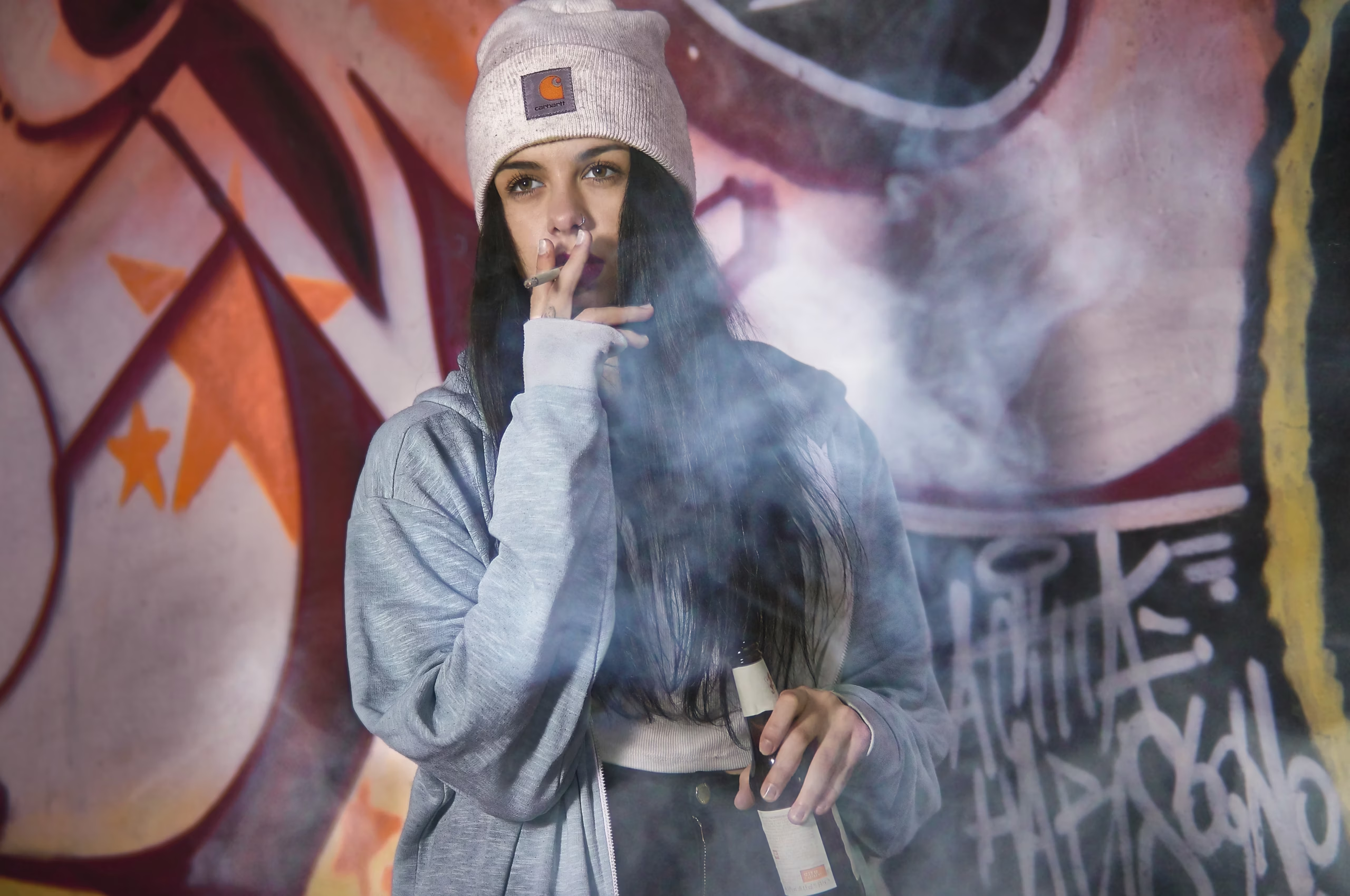
In the first image she stands before a wall covered in graffiti.
The wall screams through color.
She doesn’t.
She holds a cigarette near her lips and a bottle in the other hand. Smoke rises between her and the lens like a makeshift curtain, a little private fog where she can disappear for a few seconds.
The cigarette solves nothing.
Neither does the bottle.
They aren’t keys, cures, or revolutionary manifestos. They’re two objects to occupy your hands when you have no fucking idea where to put the rest of your life.
Every generation has invented its own small rituals for not screaming.
Some people smoke.
Some drink.
Some run until their legs hurt.
Some listen to the same song forty-three times because those words seem to know an alley in their head their friends have never found.
Others spend the night in front of a screen, scrolling through other people’s lives until their own feels far enough away.
It doesn’t change much.
We are complicated animals searching for simple anesthetics.
Back then I listened to a lot of music capable of turning anger, exclusion, and a hunger for redemption into rhythm. Perhaps some of those sounds found their way unconsciously into these photographs.
Not because this place had suddenly become a Detroit neighborhood.
But some outskirts need no passport.
There is a kind of 8 Mile inside many people: an invisible line between who we are, who others think we should be, and who we fear we may never become.
A border with no signs.
You cross it every morning when you leave home.
You cross it when you enter a room and know at once that you are different.
When everyone else seems to have received the instructions for living and you suspect your copy was lost in transit.
When everyone talks about college, work, marriage, children, mortgages, and plans for the future while you’re still trying to work out how to reach Friday night emotionally intact.
Youth is sold as one long party.
Energy. Possibility. Beauty. First times.
A marvelous vacation before taxes and back pain arrive.
What a load of shit.
Being young also means not yet knowing how long what you’re feeling will last.
At forty, you’ve already watched a few storms end. You’ve learned, at least in theory, that even the fiercest pain eventually loses its teeth.
When you’re young, you don’t know that.
A disappointment doesn’t feel like a chapter.
It feels like the whole book.
Someone leaving isn’t merely someone you lost.
It’s final proof that you will always be alone.
A failure isn’t a bad day.
It’s a verdict on the person you will become.
Everything looks enormous because you don’t yet own enough past to measure it against.
Meanwhile, the adults tell you to smile.
‘You have your whole life ahead of you.’
No shit.
That’s the frightening part.
All that road, all those decisions, all those possible chances to fuck up spectacularly and then pretend you learned something.
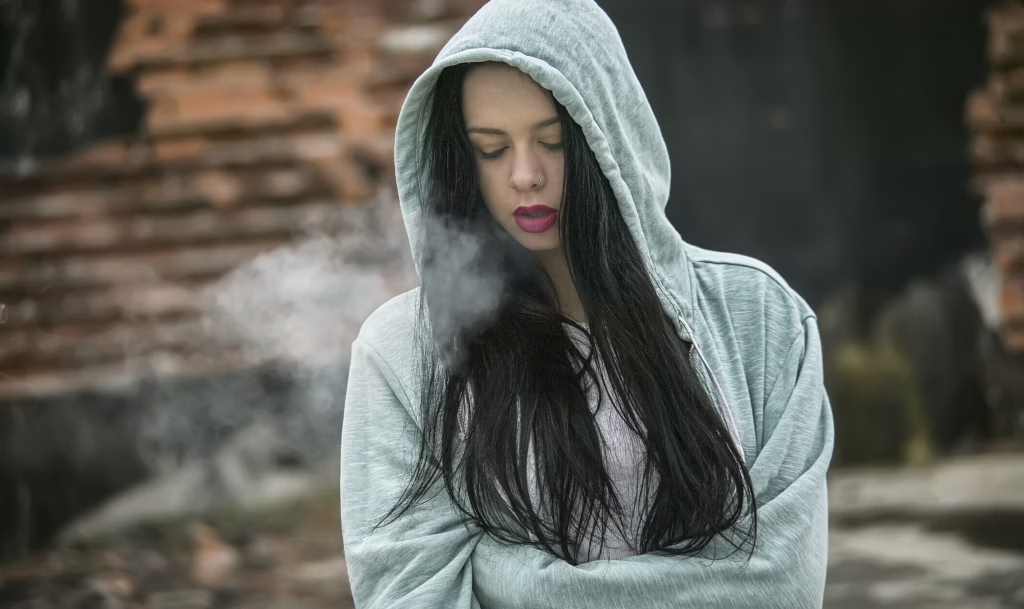
In the second photograph, the hood closes around her face.
A portable home.
Two strips of fabric and suddenly the world is a few inches farther away.
She exhales smoke and lowers her eyes.
For a moment, it looks as though a thought has escaped her body, become visible, and dissolved into the air.
If only it truly worked that way.
Take whatever oppresses us, fill our lungs with it, then breathe it out.
Watch it drift away.
Say: there, that was the fear of not being enough. That was the memory of the person who hurt me. That cloud over there was the future I cannot imagine.
All gone.
Unfortunately, certain thoughts have a terrible sense of direction.
They take a walk, stretch their legs, and come right back inside.
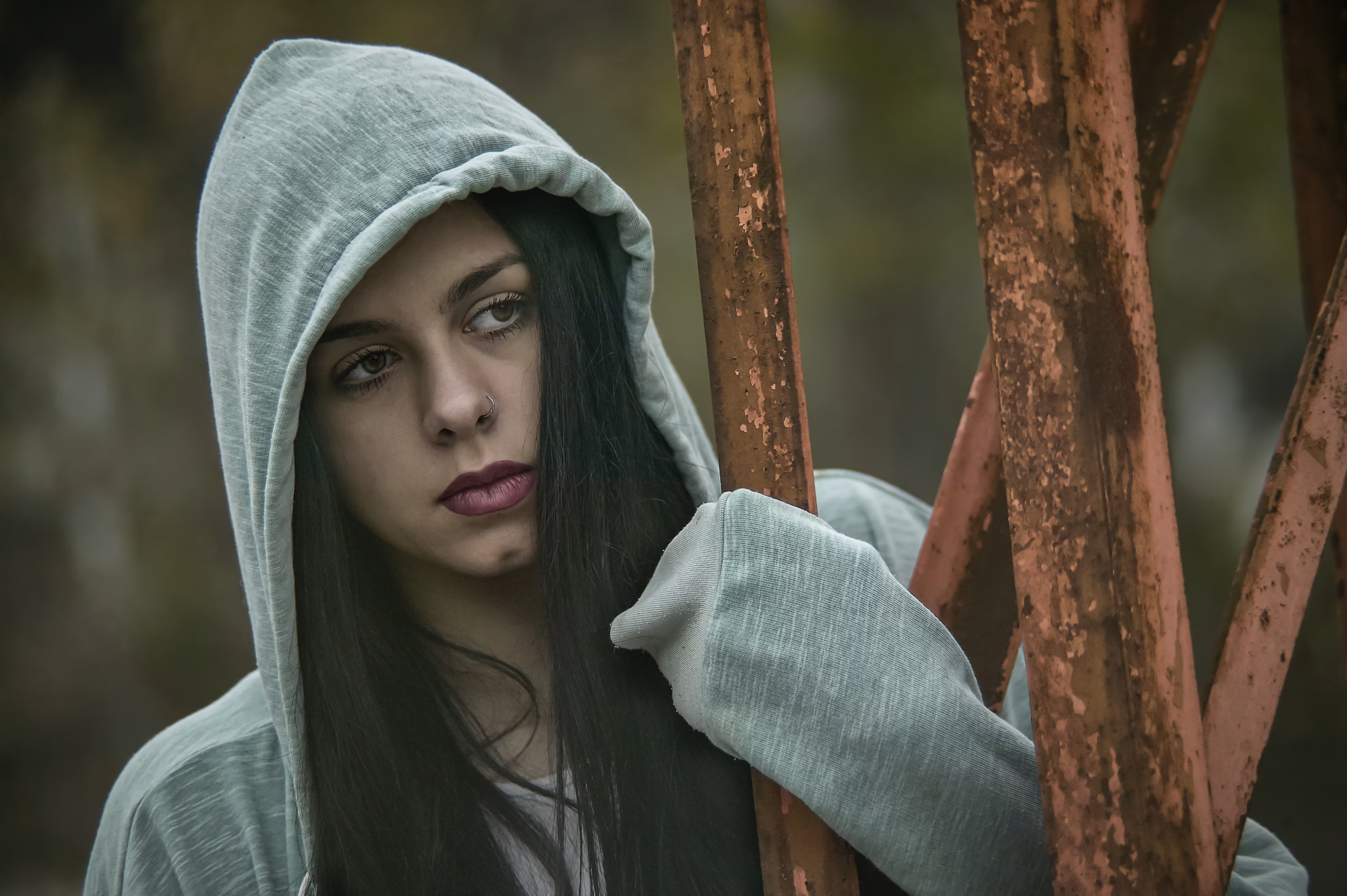
In the next image she leans against an iron structure devoured by rust.
The metal has lost its paint. Its surface is rough, wounded, exposed to the years.
And still it stands.
It isn’t beautiful in the way we usually understand beauty. It isn’t smooth, new, or perfect.
But it holds.
How many people have you met like that?
How many times have you been one of them?
Worn through in places, marked by what happened, perhaps not especially graceful in your reactions, but still standing?
There is a strange dignity in things that endure without pretending they remained intact.
Rust doesn’t deny the wound.
It absorbs it.
That doesn’t mean we should fall in love with our cracks.
Pain photographed well can become beautiful.
Smoke catches the light. Rust takes on warm colors. Melancholy deepens the eyes. A filthy room becomes cinema the moment you choose the right frame.
But let’s not confuse aesthetics with healing.
Suffering can be photogenic and still hurt like hell.
A backlit cigarette may look like poetry, but it remains burning tobacco.
A lonely night can become a story, but at four in the morning it remains a first-rate pain in the ass.
There is nothing romantic about being unable to get out of bed, feeling foreign everywhere, or carrying a weight no one can see.
Photography can give that weight a shape.
It cannot carry it for us.
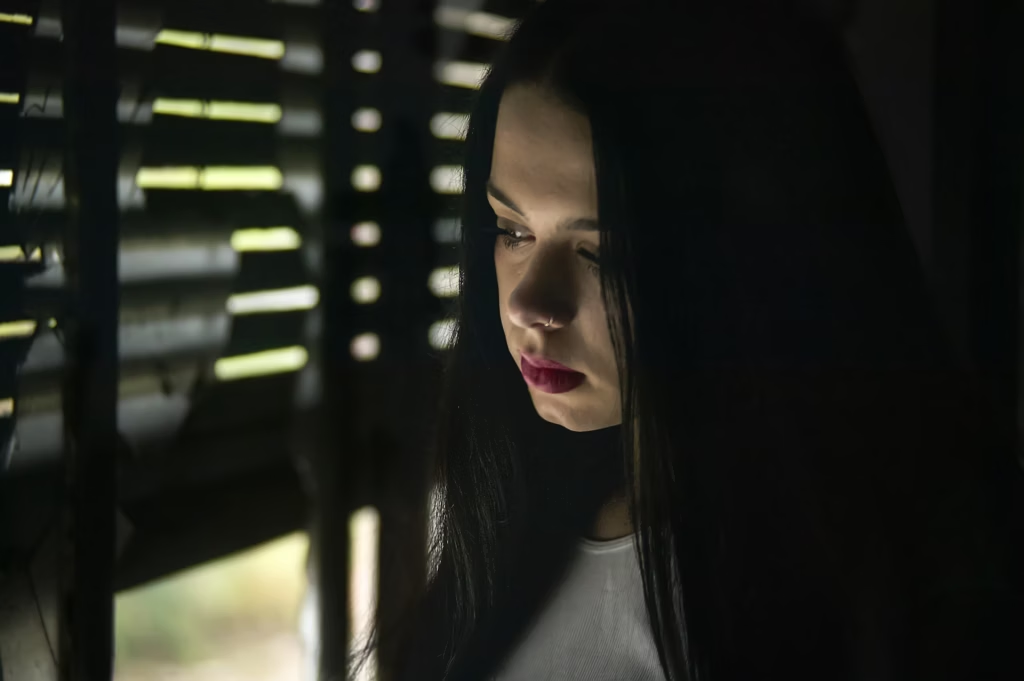
Inside the building, the light changes.
It crosses the openings and falls across her face in pieces, as if even daylight had to ask permission to enter.
She looks down.
Around her are darkness, wood, dust, old structures that no longer serve the purpose for which they were built.
Maybe that’s what frightens us most.
Not being destroyed.
Feeling unused.
Still having walls, windows, doors, and space inside ourselves, yet no longer knowing what kind of life is meant to live there.
Have you ever felt that way?
Not necessarily desperate.
Simply out of service.
As though the rest of the world found its place while you were in the bathroom and no one remembered to tell you.
Everyone else runs, plans, produces, gets together, breaks up, starts over. They display achievements, smiles, trips, bodies, and wonderful new versions of themselves.
And there you are.
Sitting on the floor of a place falling apart, your hands tucked into your sleeves and no answer pretty enough to post.
And perhaps, for a few hours, that’s all right.
Not every silence is a defeat.
Sometimes isolation is an emergency room.
You withdraw because the noise outside has begun to overlap the noise inside, and you can no longer tell them apart.
You need to stop.
To let your mind quit running.
To be neither entertaining, interesting, desirable, nor socially useful.
You need to exist without having to entertain anyone.
The problem begins when the emergency room becomes home.
When the hood stops being shelter and becomes a wall.
When you identify so deeply with your sadness that you no longer know who you would be without it.
Pain has an ego too.
It wants to be recognized. Defended. Preserved.
After a while it convinces you that healing would betray everything you’ve been through.
So you stay there.
Not because you’re well.
Because at least you know this suffering.
It’s a shitty room, but you know where the light switch is.
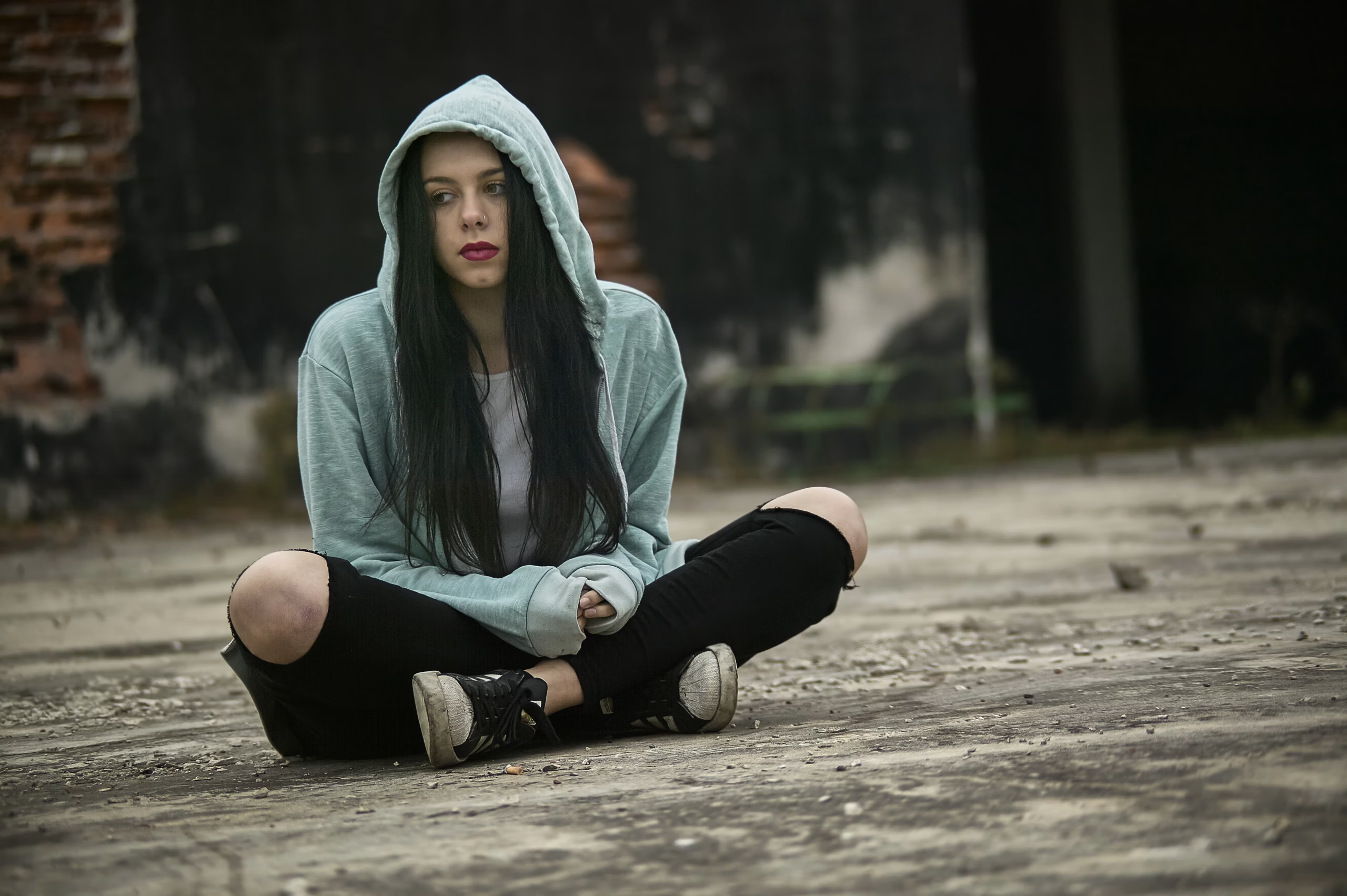
In the wider photograph, she sits cross-legged on the floor.
There is space around her.
Too much space.
The walls are far away and no one approaches her. Her body looks small inside the emptied structure, but not necessarily weak.
It is suspended.
Waiting.
Perhaps resilience doesn’t always look like someone running toward the sunset with epic music underneath.
Sometimes it may look like a girl sitting on concrete who still doesn’t know what to do, but made it this far.
She has solved nothing.
She hasn’t found the answer.
She hasn’t turned trauma into a million-dollar business or launched a podcast to tell everyone else how to live.
She breathes.
For that day, it may be enough.
Then she stands again.
Arms folded, hood over her head, eyes turned toward the sky with the expression of someone who has just heard one more piece of unsolicited advice.
That photograph introduces something different.
No longer only sadness.
Annoyance.
Defiance.
A kind of silent: ‘Yes, I get it. Now you can stop busting my fucking balls.’
There is a subtle violence in demanding that people get better according to our schedule.
We see them sad and it makes us uncomfortable.
So we want to fix them.
Not always for their sake.
Often for ours.
Their pain reminds us that life can jump the tracks without permission. We would rather stand them up quickly, comb their hair, wash their face, and return them to society with a certificate of restored functionality.
But some things need time.
Some wounds don’t want a speech.
They want space.
And some people refuse to conform not because they planned some grand rebellion, but because they haven’t yet learned to smile on command.
Maybe they never will.
Good for them.
The world is already full of professional smiles, prepackaged opinions, and personalities furnished by someone else.
It doesn’t need another.
The final image takes us back inside.
She is seated, folded inward, her head resting on one hand. Her face is tired. The room is filthy, the shutters closed, and the little remaining light seems as weary as she is.
There is no triumphant ending.
No sudden smile.
No door flung open onto a better future.
Only a girl and her silence.
And that is as it should be.
Not every story has to end at the moment its protagonist finally understands everything.
Most of our days end sooner.
In doubt.
In exhaustion.
With a question left on the table and the sense that tomorrow we’ll have to pick up the conversation again.
Perhaps these photographs aren’t meant to show us how to escape melancholy.
Perhaps they are meant to remind us what it looks like from the inside.
Without diagnosing it.
Without turning it into a fashionable pose.
Without turning every girl in an oversized hoodie with lowered eyes into yet another damned character engineered to seem interesting.
I don’t know what she truly felt.
I only know that in that place, through those images, her face and the ruins began to speak the same language.
A language made of concrete, smoke, rust, empty rooms, and things that continue to exist even after being left behind.
Perhaps that is precisely why we went in.
Because on certain days intact places make us feel even more broken.
Orderly rooms demand explanations.
Ruins don’t.
Ruins don’t ask why you aren’t smiling.
They don’t tell you it will pass.
They don’t compare your pain to someone who has it worse.
They let you sit.
They let you breathe.
They allow you, for a few hours, to resemble what you carry inside.
And while you remain there among peeling walls and silence, they may remind you of something we forget far too often:
being wounded doesn’t mean being finished.
Sometimes it only means time passed over us too.
It stripped away some paint, opened a few cracks, and let the cold in.
But we’re still here.
Not perfect.
Not healed.
Not especially photogenic at seven in the morning.
But still standing.
Perhaps we didn’t enter that place to photograph what had been abandoned.
Perhaps we entered because, for one afternoon at least, it knew how to shelter the part of us the rest of the world didn’t want to see.