

Mexico, Chapter II — Isla Mujeres
The second chapter of this journey begins in a bed that was not mine.
If you were expecting a ferry, a map, or the reassuring outline of some monument, I am sorry to disappoint you. Real journeys rarely obey the order prescribed by guidebooks. They get dirty with life, take detours, miss connections, and sometimes begin with clothes on the floor and two people who, until recently, knew almost nothing about each other.
I had only just met her there.
She had invited me into her home, and that night we did what two adults do when attraction moves faster than caution and neither feels any need to submit it to the judgment of a moral committee.
It was a damn good fuck.
There is no particularly refined way to say it, and if there were, it would probably spoil the memory. There were bodies, laughter, sheets forced to endure questionable decisions, and the absolute carelessness you feel only when no one is trying to turn an encounter into a contract for the future.
She mentioned multiple orgasms.
Her exact words.
There was no notary present, nor any scientific committee appointed to certify the claim, so you will have to trust the firsthand testimony. As for me, I found no reason to dispute the review.
It was not a conquest, and she was not another stop to add to the itinerary. She was simply a woman with whom I shared a beautiful, free, adult night. No promises spoken at the wrong moment, no pathetic attempt to turn pleasure into destiny. Just two people making each other feel good for a few hours.
Sometimes that should be enough.
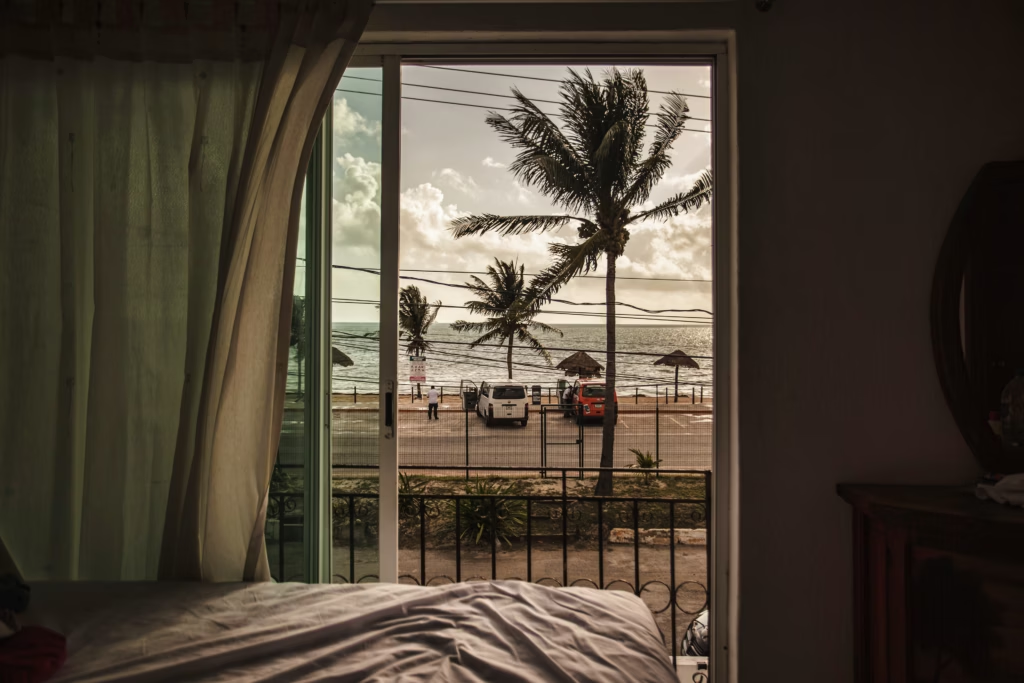
The breeze entered through the window and stirred the curtains. Outside were the palms, the road, and the sea. Inside remained the heat of our bodies, the disorder of the sheets, and that pleasant exhaustion that feels nothing like fatigue. It is your body telling you that, for at least one night, you stopped thinking too much and did something wonderfully simple: you lived.
In the morning, I woke to that view.
The bed still occupied the lower edge of the photograph. It was unmade, naturally. A perfectly tidy bed after a night like that would have been an insult to honesty. Beyond the sheets, the window framed a palm and, farther still, the sea.
The horizon was there.
A nearly innocent line dividing sky from water, seeming to ask what I intended to do next.
Have you ever woken in a room that was not yours and felt, for some reason, that you were exactly where you belonged?
Not forever.
“Forever” is an overrated concept, often used to ruin things that had been working perfectly well without it. I mean that exact moment. That window, that bed, that woman, and that light. For a handful of minutes, nothing was missing.
Then I looked beyond the glass.
Beyond the palm.
Beyond the night just spent.
Out there was the sea and, somewhere past that horizon, Isla Mujeres.
I got up, gathered my clothes and my camera. I was still wearing the night, the scent of skin, and the kind of good mood no cup of coffee has ever managed to produce legally.
That was how the day began.
With a beautiful fuck behind me and an island ahead.
Honestly, there are worse plans.
The harbor came soon afterward. Colorful boats, ropes, docks, scrap metal, and enormous clouds over the water. The sea had shed the orderly calm of the photograph taken from the room and begun to move, striking the boats and filling the air with salt.
I climbed aboard.
The mainland receded and, for a while, I belonged nowhere. I was no longer in the room from the night before and not yet on the island. I was in between, which may be the most honest condition a human being can inhabit.
We spend much of our lives pretending we have arrived somewhere. In truth, we are almost always on a metaphorical ferry, our footing slightly unsteady, a past receding behind us and no guarantee the harbor ahead is the right one.
But that morning, I did not need guarantees.
I had wind in my face, a camera, and a more than respectable quantity of endorphins still circulating through my bloodstream.
Isla Mujeres appeared slowly.
Even the name seemed to possess a certain sense of humor. Given the way the day had begun, heading toward a place called the “Island of Women” felt too perfect to be entirely accidental. Evidently, when the universe wants to, it can be one brazen screenwriter.
The island was picturesque without trying to be.
It had no need to clean every corner or conceal its contradictions. Beauty and decay lived side by side, sometimes on the very same wall. There were buildings worn by salt, uneven roads, cars that seemed to have survived several lives, and doors painted in colors capable of making abandonment look like an aesthetic choice.
An old Volkswagen Beetle sat parked along the road, its body corroded and roof ruined. It should have looked sad. Instead it possessed an almost insolent dignity. It seemed to say: I am still here, assholes. I am not beautiful by your standards, I am not worth enough to restore, and I will probably never start again. But I am still here.
Perhaps this was the language the island spoke.
The language of things that remained standing without anyone bothering to make them perfect.
The walls were covered in figures, skulls, animals, and deities. Façades became canvases. Blue doors interrupted white walls, and cacti grew beside entrances like silent guardians. Even decay seemed to refuse becoming entirely gray.
I do not want to romanticize poverty.
I have said it already and will keep saying it: being poor is awful. It does not automatically make anyone good, pure, wise, or happy. A lack of money is not a spiritual path; it is a concrete limitation that decides where you can live, what care you can receive, and how much freedom you are allowed to buy.
But in certain places, I have seen people with very little still surround themselves with color, invention, and human gestures.
Back home we own far more, yet still manage to live in taupe apartments, speak only to the delivery driver, and treat dinner together as an obligation to schedule three weeks in advance.
On the island, life remained exposed.
A woman sold objects made from shells and fragments of the sea. Sunlight struck her face and passed through the little shapes hanging around her, turning the stall into a handmade constellation.
A little farther on, a sign promised something for thirty pesos. I do not even remember what. Perhaps it did not matter. I remember the hands, the streets, the people sitting outside the shops, and the sense that behind every object was still someone who had touched it.
It was not the sterile perfection of Western stores, where everything arrives packaged, illuminated, and stripped of every human trace. There, things still seemed to belong to the people who had made them.
Even the shells, hanging side by side, continued to hold something of the sea.
Then I met a coati perched on a branch.
It looked at me with the expression of someone who had seen enough tourists to develop a fairly severe opinion of our species. It stayed there, agile and perfectly at home in its own world, while I searched for the frame.
My camera did not impress it much.
It was right.
The island was full of presences that had no need of us: animals, plants, rocks, waves, and birds suspended above the coast. We arrived, took photographs, bought a souvenir, and left convinced we had discovered something. They went on living exactly as before.
I moved toward the farthest end of the island.
The lighthouse, the statues, and the paths looked out over a sea that seemed endless. The land grew thin, almost tired of resisting the water. Waves struck the rock with methodical violence, repeating the same gesture for thousands of years without either side managing to declare victory.
There was something magnificent in that useless struggle.
The sea did not truly want to destroy the stone. The stone did not seriously expect to stop the sea. They were simply doing what they had been born to do.
We, on the other hand, spend half our lives trying to become something else and the other half complaining that we no longer know who we are.
At Chichén Itzá, stone had been raised toward the sky to challenge time. Here on the island, it became small again. Someone had gathered rocks and stacked them one on top of another, building tiny monuments exposed to the wind and the first sufficiently pissed-off wave.
Little pyramids without priests.
Altars without gods.
Temporary attempts to say: I passed this way.
It is funny. First we build enormous temples to become immortal, then five stones balanced before the sea are enough to give us precisely the same feeling.
Perhaps all art is born from this slightly pathetic and marvelous need: to leave something behind before the tide erases our footprints.
I was doing the same thing.
My stones were photographs.
I kept walking.
There were docks thrust into the water, boats pulled ashore, and small buildings exposed to the wind. There were wet streets, signs, murals, and open storefronts. The island changed its face around every bend. It could turn noisy, poor, colorful, decaying, then suddenly open onto a stretch of coast so beautiful that every definition fell away.
Then came the children.
Two small figures played near the water. No phones, no schedule, no pose. Only the advancing sea, the two of them waiting for it, and that narrow distance between fear and curiosity that children cross constantly.
Perhaps growing up means learning to keep farther away from the waves.
We begin to fear getting wet, falling down, looking ridiculous. We convince ourselves caution is always a form of intelligence when sometimes it is only the elegant name we have given surrender.
The children, instead, moved in and out of the water.
The sea drove them back, and they returned.
No one had yet explained that, by the rules of the adult world, after a certain number of defeats we are supposed to stop trying.
The afternoon began to tilt.
The light grew lower, warmer, almost indecent. The palms became silhouettes, the sand absorbed the color of the sky, and the people on the beach slowly stopped being individuals and became small presences inside something larger.
The sun was going down, and no one seemed in any hurry to send it an email.
Some people walked, others stood watching, and someone kept playing at the water’s edge. The sunset belonged to no one, and that was precisely what made it magnificent. You could not reserve it, buy it, or fence it inside private property.
You could only be there.
In the West, we have turned almost everything into merchandise. Time, attention, the body, solitude, travel, even silence. But before a sunset, money returns for a few minutes to what it has always been: conventional paper incapable of persuading the sun to stay a little longer.
The day had begun with a woman, an unmade bed, and a window open to the horizon.
It ended with my body stretched across a hammock before the same sea.
My legs raised, the fabric swaying slowly, and the light now weary over the rocks. I had found no particular answer. I had not discovered the meaning of existence, and Isla Mujeres had not handed me some ancient truth to carve into my biography.
I had simply felt good.
Which sounds like very little only to those who have forgotten how rare it is.
I thought back to the night before, the breeze coming through the window, that woman’s words, and the freedom with which we had met without asking each other to become something else. Then I thought of the ferry, the streets, the painted walls, the woman among the shells, the children, and the little towers of stone before the sea.
Everything seemed connected by the same fragile idea.
Nothing I had lived was meant to last.
The night was over.
The sunset was ending.
The stones would fall.
I would leave the island.
And yet it had all been real.
Perhaps happiness is not the permanent condition sold to us in books, advertisements, and the profiles of people who smile too much. Perhaps it is only a temporary alignment of circumstances: a person met at the right moment, an open window, wind on your skin, a boat ready to leave, and the chance to look at the horizon without anyone asking where you will be five years from now.
I did not know it that morning.
Truthfully, I do not know it even now.
But for one night and one entire day, I did not need to know.
I had an island ahead, the sea beneath me, and enough light to keep taking photographs.
The road to Tulum could wait.