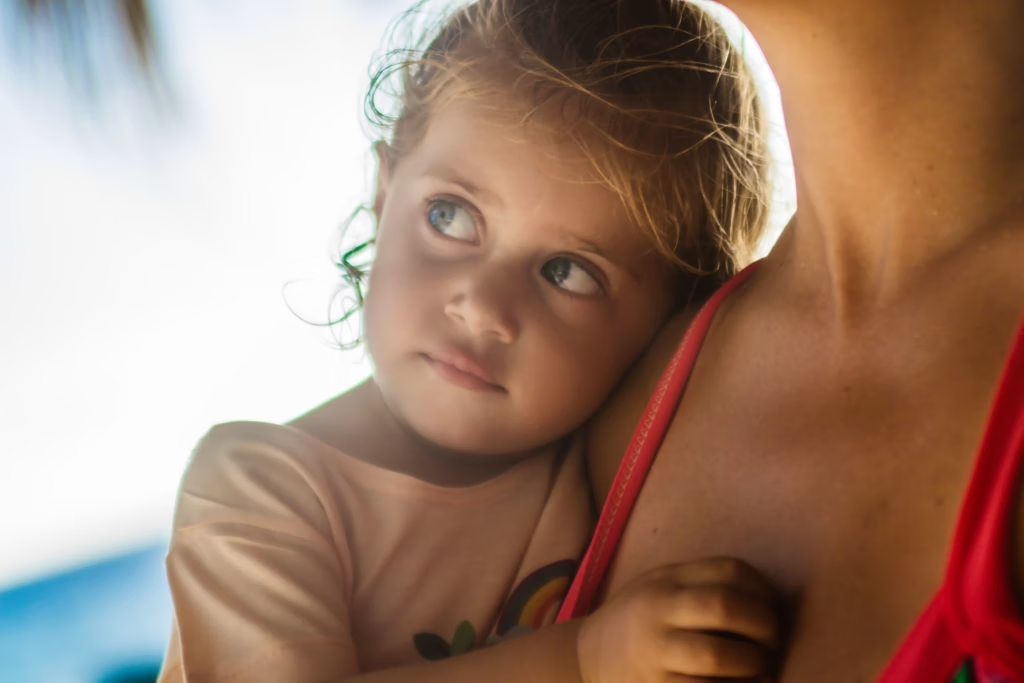
I do not remember where I took these photographs. My hard drive preserved the year but not the place, and the background has dissolved too completely to offer a clue.
Perhaps that is all right.
Before the lens were a mother, her daughter, and the kind of embrace inside which the rest of the world can go take a walk for a few minutes. My eye chose them. Memory forgot everything else.
I do not remember where I was.
I know these photographs date back many years because the folder on my hard drive—a considerably more reliable archivist than my memory—still carries a date. But I remember nothing about the place. No city, event, or street.
The background offers no help. It is light, color, a few shapes drowned out of focus.
Perhaps because while I was shooting, I did not care where we were.
That was the place.
A little girl resting against her mother’s chest.
In the first photograph, the mother smiles, lowers her face toward her daughter, and holds her. The girl’s eyes are down, her face sheltered against her mother’s body, one small hand clinging to a shoulder.
In the second, the mother almost disappears from the frame. What remains is the body against which the child continues to lean while her eyes look elsewhere. She does not appear frightened. She seems simply free to observe the world, knowing she has already found a place to which she can return.
It is not a spectacular scene.
No birthday, gift, or ceremony. None of that loud happiness demanding to be seen and photographed from every angle.
There is something smaller.
And for that very reason, more important.
Safety.
That almost invisible feeling a child could never explain but recognizes with her entire body: here I do not have to defend myself. Here I can lower my guard. Here someone holds me without asking me to be different from what I am.
Before words, we learn the world through the arms that gather us in.
A mother is the first place.
The first shelter.
The first mirror in which a human being searches for confirmation that they deserve love.
Giving birth is not enough. That is biology, the old trick through which life keeps replicating itself. Being a mother is what begins afterward: on ordinary days, sleepless nights, through tantrums, fears that seem foolish only to adults, and hundreds of gestures no one will applaud.
A mother’s love does not live only in great sacrifices.
It lives in the tone used to speak a name.
In the patience with which a badly told story is heard.
In the smile offered when a child seeks approval.
In the way she is held after a fall without being taught to fear the floor forever.
Teaching love does not mean telling a child the world will always be kind. That would be a lie, and sooner or later children present the bill for those as well.
It means showing that kindness exists.
That it can be chosen.
That it is not weakness, naivety, or submission. It is the courage not to automatically return to others all the shit life handed us.
A mother teaches this above all without speaking.
Children take notes without a pen.
They watch how we treat those who can offer us nothing. How we speak about people who are absent. How we react when tired, when wrong, when someone hurts us. They learn whether love is a shelter or a prize earned by behaving well.
They learn whether apologizing is defeat.
Whether crying is shameful.
Whether smiling is natural or something worn when guests arrive.
Every gesture becomes a small road sign along the path they will travel.
That is why a mother’s love should not build a fence around her daughter. It should give her enough security to cross the gate one day.
Hold without holding back.
Protect without possessing.
Guide without turning your own fear into someone else’s prison.
Say through thousands of daily gestures: “You are not here to become the person I imagined. You are here to become yourself. I will try to give you the tools; then the road will be yours.”
That little girl will grow.
One day she will no longer fit inside those arms with the same ease. There will be doors slammed too hard, words badly spoken, incomprehensible choices, and the necessary distance through which every child tries to learn who they are beyond their family.
Life will have plenty of time to teach her its bullshit.
People who promise and then disappear.
Disappointments.
The doubt that she is not enough.
The temptation to accept too little just to avoid being alone.
A mother cannot prevent every pain. Trying would also prevent her from living.
But she can leave her something more useful than the illusion of invulnerability: the certainty that she deserves respect, and the memory of a love in which she did not have to keep proving her worth.
Perhaps the child will not remember that afternoon.
Childhood memory is full of holes. It retains useless details and drops entire days: light on a wall, a smell, the sound of a door, while hundreds of embraces disappear without leaving a single conscious image.
But the body remembers differently.
It remembers whether it could relax.
The sound of a voice.
The possibility of resting your head against someone without fearing rejection.
And years later, when that child has become a woman and must choose whom to let into her life, perhaps she will not remember this exact moment. But some part of her will still recognize the difference between someone holding her and someone suffocating her.
Between someone who loves and someone who possesses.
Between a home and a cage.
Perhaps this is one of the most important inheritances a mother can leave a daughter: not only the love she received, but the ability to recognize it when it returns in other forms.
In a friendship.
In a relationship.
In the way she learns to treat herself.
These photographs do not show all of this. They cannot. They stop only a fraction of a second: a mother smiling, a child leaning against her, a small hand wrapped around a shoulder.
And yet sometimes a fraction of a second already contains the direction of a life.
I do not remember the city.
The street.
What stood behind them.
But perhaps I did not forget the place.
The place was her mother’s body.
Her first home.
And everything else, for once, could safely remain out of focus.