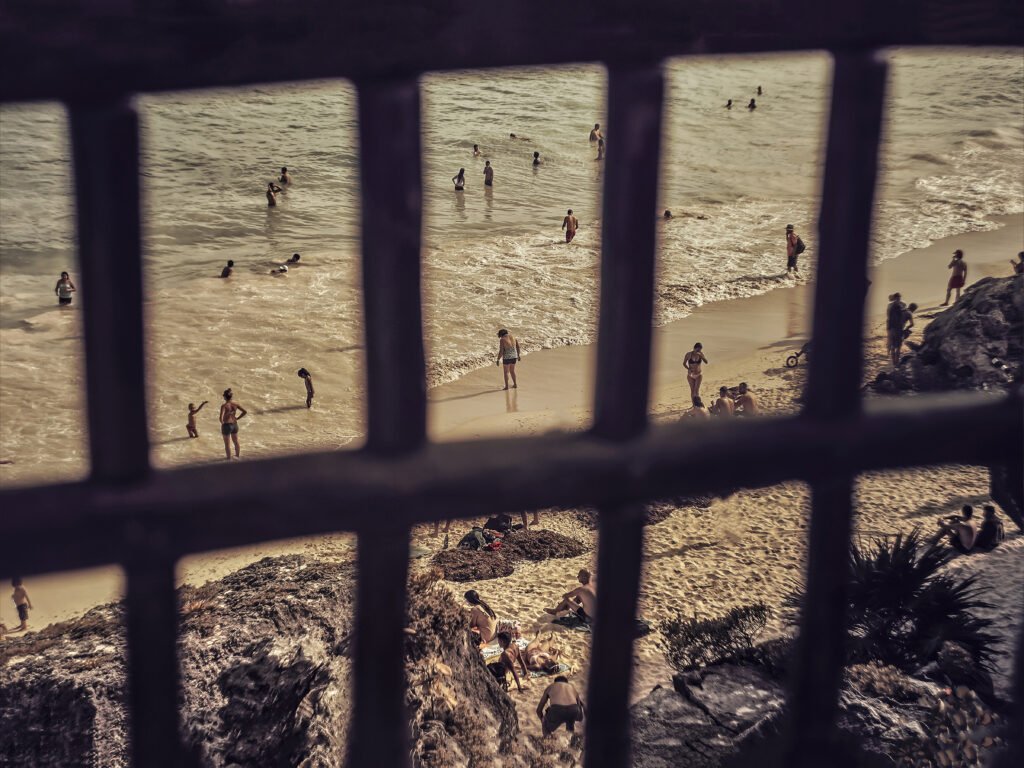
There are two photographs, taken years apart.
In the first, a wooden fence—the kind that separates one place from another without pretending to be a wall. In the second, an old railing in Venice, the sort of barrier cities build more from habit than necessity.
The material changes, the light changes, and probably the man taking the picture changes too—because there are years in between, and years never pass without leaving something on you, even when everything appears to have remained the same.
But look closely and the scene is always the same.
On one side, the people. Moving, occupying space, laughing with the ease of those who never stopped to ask whether they had the right to be there. On the other side—always the other side—me. With a camera where my role in the scene should be.
It is not shyness. It is not even fear, though for years I told myself it was, because a simple explanation is more comfortable than something much older than social unease.
It is a position. Something I discovered I possessed rather than chose to wear—like discovering you are left-handed, or that your voice is recognizable even over the phone. A kind of factory-installed distance that a fence or railing merely makes visible: two inches of wood or masonry telling an entire vision of the world.
Because that barrier is not keeping me out.
I am the one who chose to remain behind it. Even when no one was watching. Even when I could have climbed over without anyone noticing.
They live the scene. I frame it.
They decide what to do with the afternoon. I decide which instant of that afternoon deserves to outlive the afternoon itself.
Some people spend their lives searching for the exact center of the stage. Others realize early—often too early, before they even have the tools to understand what it means—that their eyes were made for the edges. Not through exclusion. Through a kind of vocation I never signed up for but practice all the same whenever someone laughs louder, dances better, or loves more freely than I can from this position.
And yes, sometimes it hurts.
It hurts while others live their summers, their wrong loves at the right time, their small disasters fit to be told the morning after—and I stand there with a finger on the shutter, deciding which fragment of that life deserves to be stopped. As though someone had entrusted me with a duty no one ever truly assigned, yet which has become the only language I know for remaining in the world without drowning in it.
Perhaps it is a sentence.
Or perhaps merely a different way of participating—not with the body, which remains outside the fence, but with the gaze, which enters all the way, farther than it ever could while comfortably inside the scene playing its own part and never once looking from the outside.
Because all those faces beyond the fence—or railing, it makes no difference—will one day stop laughing in precisely that way. They will stop standing on that exact spot beneath a light that will never return unchanged. And if no one had watched them—truly watched, with the stubborn attention of someone who knows every instant has already begun to disappear while it is still being lived—nothing would remain. Only the fading memories of those who were there, growing less reliable every year.
Two photographs. Years apart. A beach in one place, the unmistakable landscape of Venice in another.
The same fence, in the end. The same railing.
The same man, a world away from those doing the living, doing the one thing he has always known how to do well:
remain outside the scene so he can tell it to those who were not there—and perhaps one day, even to those who were there but did not look closely enough.